I keep thinking about how wildflower garden border ideas are kinda like magic tricks. From far away it looks effortless, like nature did it all. But up close, you can see the choices, the repeating shapes, the sneaky paths that pull you forward. Your 18 photos made me want to grab gloves and start planting right now.
Table of Contents
Wildflower garden border ideas: A secret woodland lane border
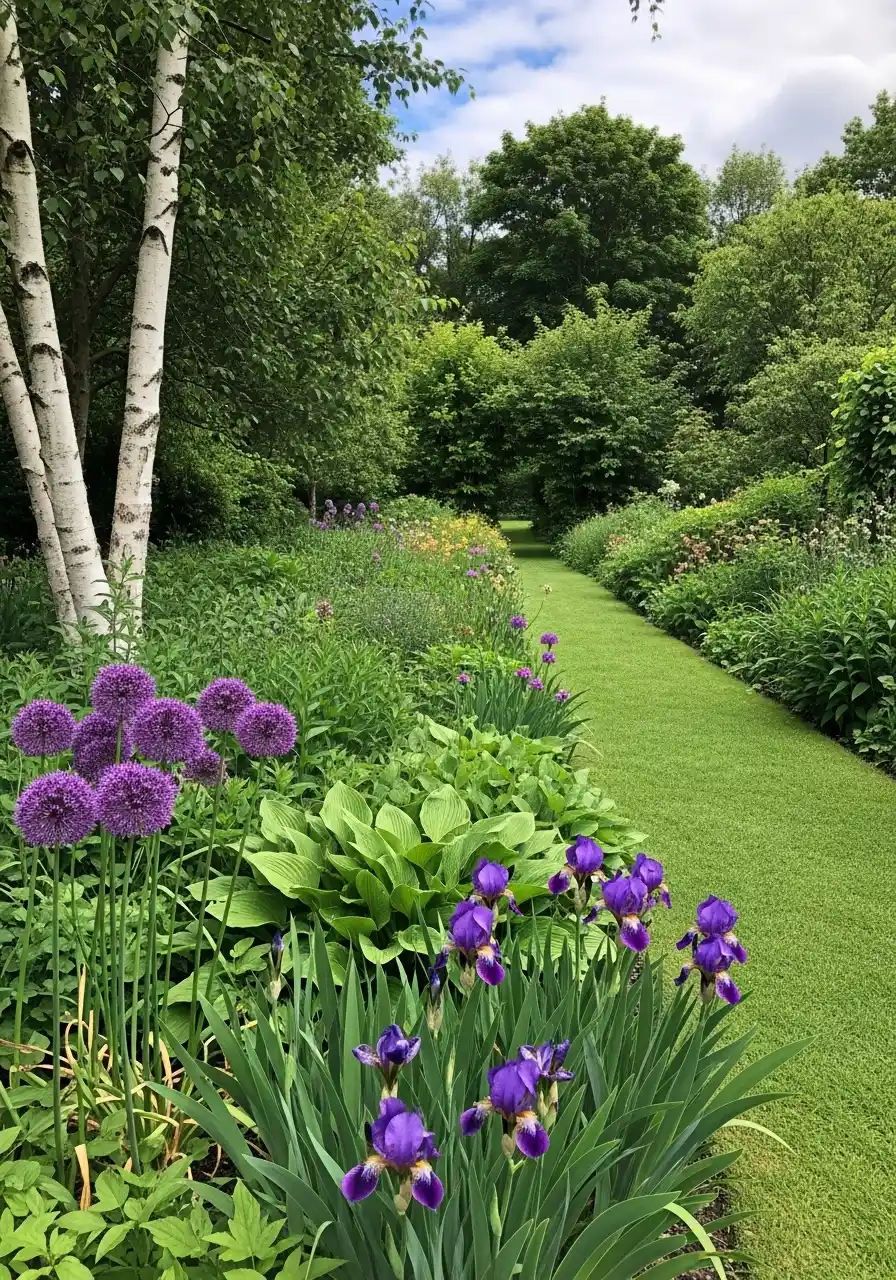
This first scene feels like a quiet green hallway, with a soft lawn path and borders that lean in just enough. I love how the plants aren’t screaming for attention, but they still feel special. The purple alliums and those deep purple irises are like little “stop and stare” moments. For wildflower garden border ideas like this, I’d copy the calm layout first: a long ribbon border on both sides, and a clean path that stays simple.
What makes it work is the layering. Big leafy clumps (hosta-type shapes) sit low and wide, then taller bloom stems pop up in front like punctuation marks. If you want this look, plant in drifts, not singles. Put 3–7 of one plant together, then repeat it again farther down. That repeat is what makes a wildflower border idea feel planned, not messy.
My tip: don’t edge the border with tiny stuff here. Let the leaves spill a little, it looks softer. And yeah, I’m guilty of over-edging because I get nervous about “weeds,” but this style looks better when it’s slightly relaxed.
Foundation curve with bold daisies and soft grasses
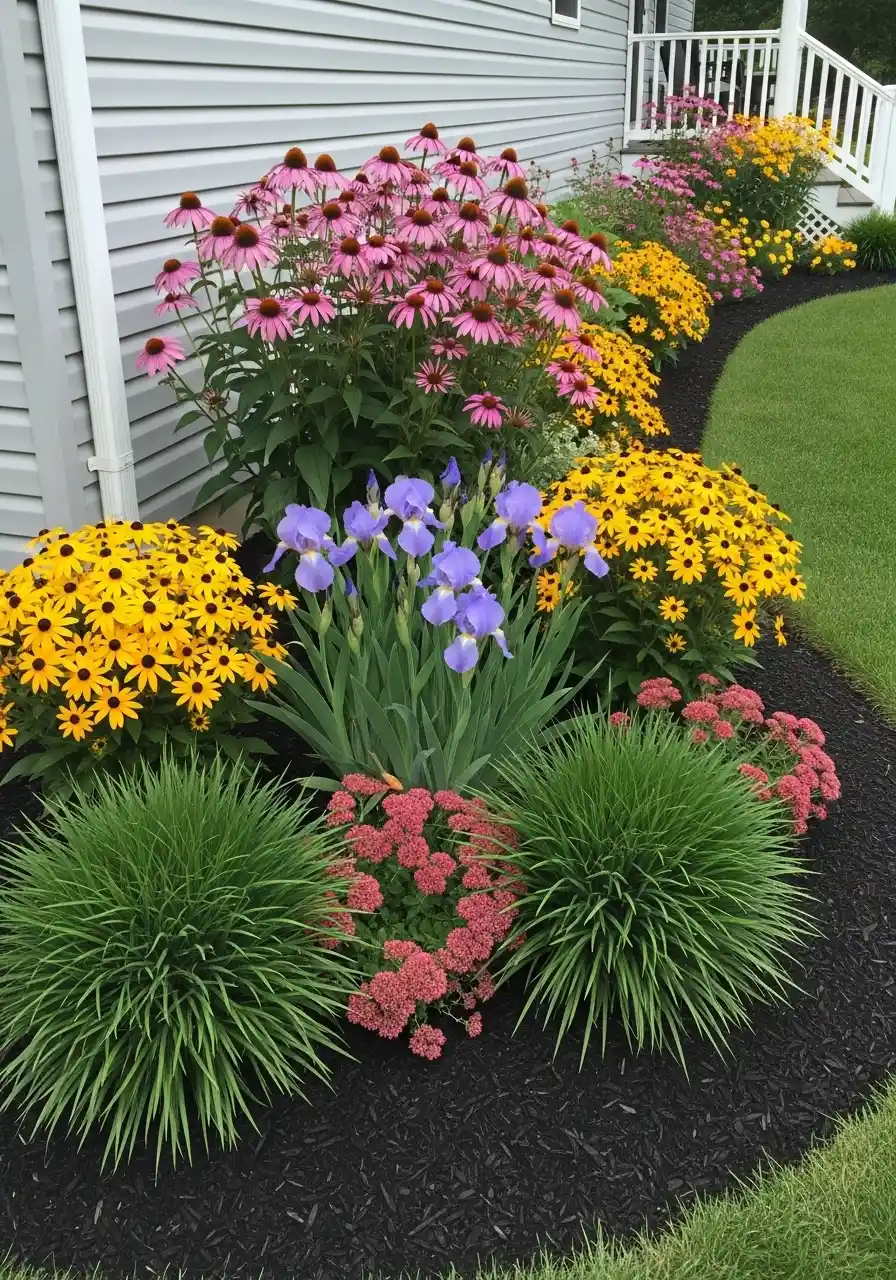
This border hugs the house in a smooth curve and it’s honestly satisfying to look at. The black mulch makes the colors pop, and the plant shapes are super clear: big yellow daisy mounds, pink coneflowers, spiky iris, and round grassy tufts. For wildflower garden border ideas near a home, this is a safe win because it looks tidy without feeling stiff.
To build it, I’d start with the curve first. Use a garden hose to draw the line, then step back and squint. If the curve feels “too sharp,” smooth it out. Then plant in groups: 3 coneflowers together, 5 black-eyed Susans together, 3 iris clumps, and 3 grass mounds. It sounds repetitive, but repetition is the whole trick.
A hack I swear by: leave a small mulch “moat” between plants while they fill in. It keeps weeds down and gives you room to adjust. And if you’re like me and you buy one extra plant every time, that extra space saves you from cramming things in weird.
A flower tunnel path with zinnias on both sides
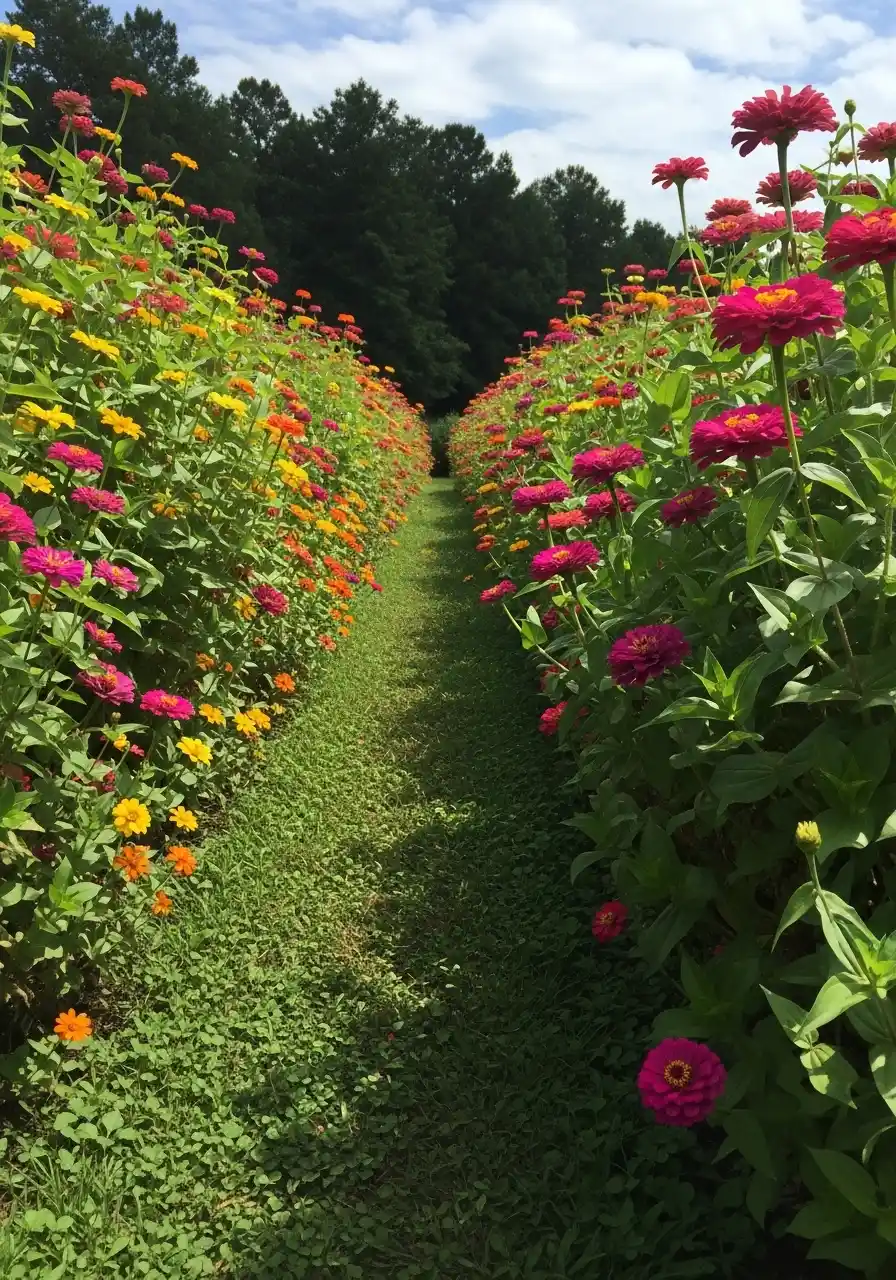
This one is pure joy. A narrow grass path, and then tall, bright wildflowers on both sides making a tunnel. It feels like you’re walking into a secret. I know these are more “cut-flower” vibes, but it still fits wildflower garden border ideas because the feeling is loose, colorful, and abundant.
If you want this, don’t plant in random colors everywhere. Pick 3–5 colors and repeat them down the line. Like hot pink, orange, yellow, and a little red. Keep the height consistent so the path feels enclosed. Zinnias, cosmos, and tall marigolds can do this. Sun helps a lot here, so place it where it gets a solid chunk of daylight.
Little confession: this kind of border can look messy fast if you skip maintenance. Deadhead weekly, even just 10 minutes. Also, plant supports are not optional if you get wind. I used to pretend “they’ll be fine,” and nope. They flop, and then I get mad at the plants like it’s their fault.
Stepping-stone trail through bright mixed blooms
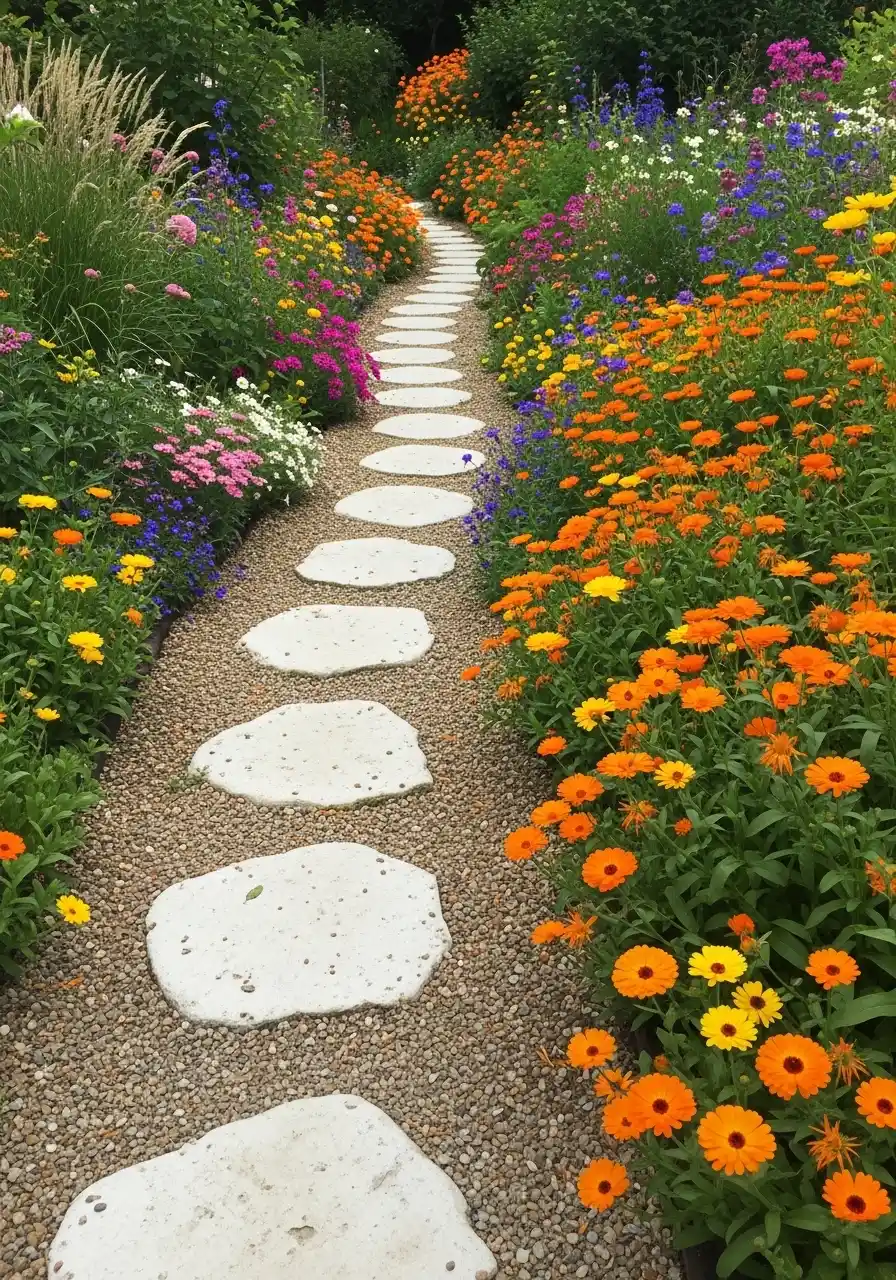
This path is playful. The stepping stones lead you through color on both sides, and the gravel keeps it clean. I love how the flowers feel like they’re waving at you as you walk. For wildflower garden border ideas, adding a path is basically cheating because people will follow it automatically, and suddenly the border feels like a destination.
To copy it, keep the stones the same size and spacing so it feels easy to walk. Then plant big color blocks, not tiny dots. Orange blooms on one side, blues and purples scattered for contrast, and soft whites to calm it down. I’d mix zinnias, salvias, coreopsis, and asters depending on your season. The main thing is to mix flower shapes, not just colors.
A practical tip: leave at least 18–24 inches from the stone edge to taller plants. Otherwise you’ll brush against wet flowers and get pollen on your shirt. I learned that the annoying way, walking to the mailbox looking like I hugged a sunflower.
Cottage-style stone path with daylilies and purple spikes
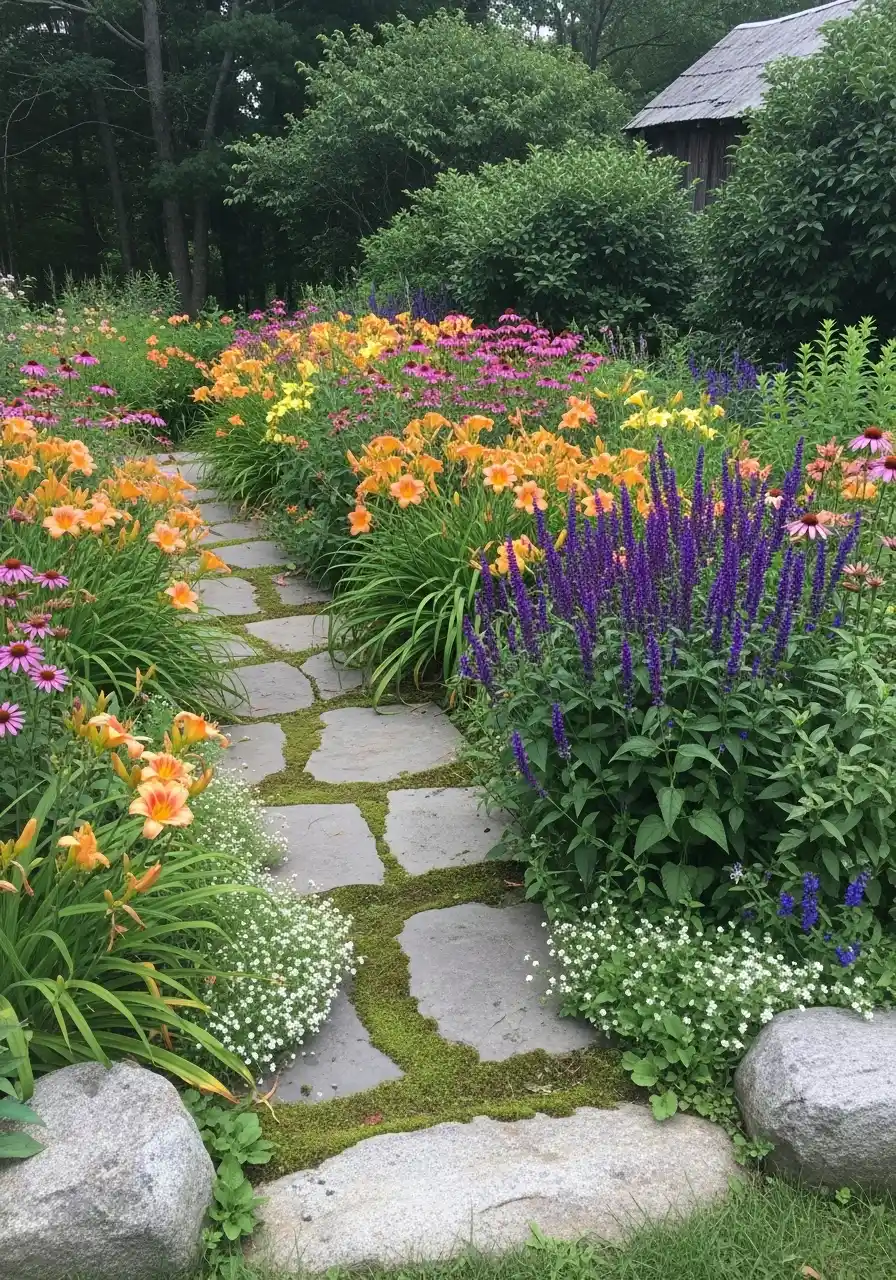
This border feels like a warm old garden that’s been loved for years. The stone path is irregular, there’s moss in the cracks, and the planting is generous. Those orange daylilies are doing the loud work, while the purple spikes (salvia-like) add vertical drama. As wildflower garden border ideas go, this one feels romantic without trying too hard.
If you want it, don’t over-straighten anything. Use irregular stones, let thyme or moss creep in, and plant in flowing waves. Daylilies (or similar strappy-leaf plants) make great “rivers” through a border. Then add purple spikes in clumps so your eyes bounce along the path.
My personal opinion: this style forgives mistakes. If a plant dies, you tuck another one in. If something spreads, you pretend it was planned. Just keep the path edges clear so the walkway stays usable, because a pretty garden border is still annoying if you can’t walk it.
Gravel walk with grasses and strong yellow repeats
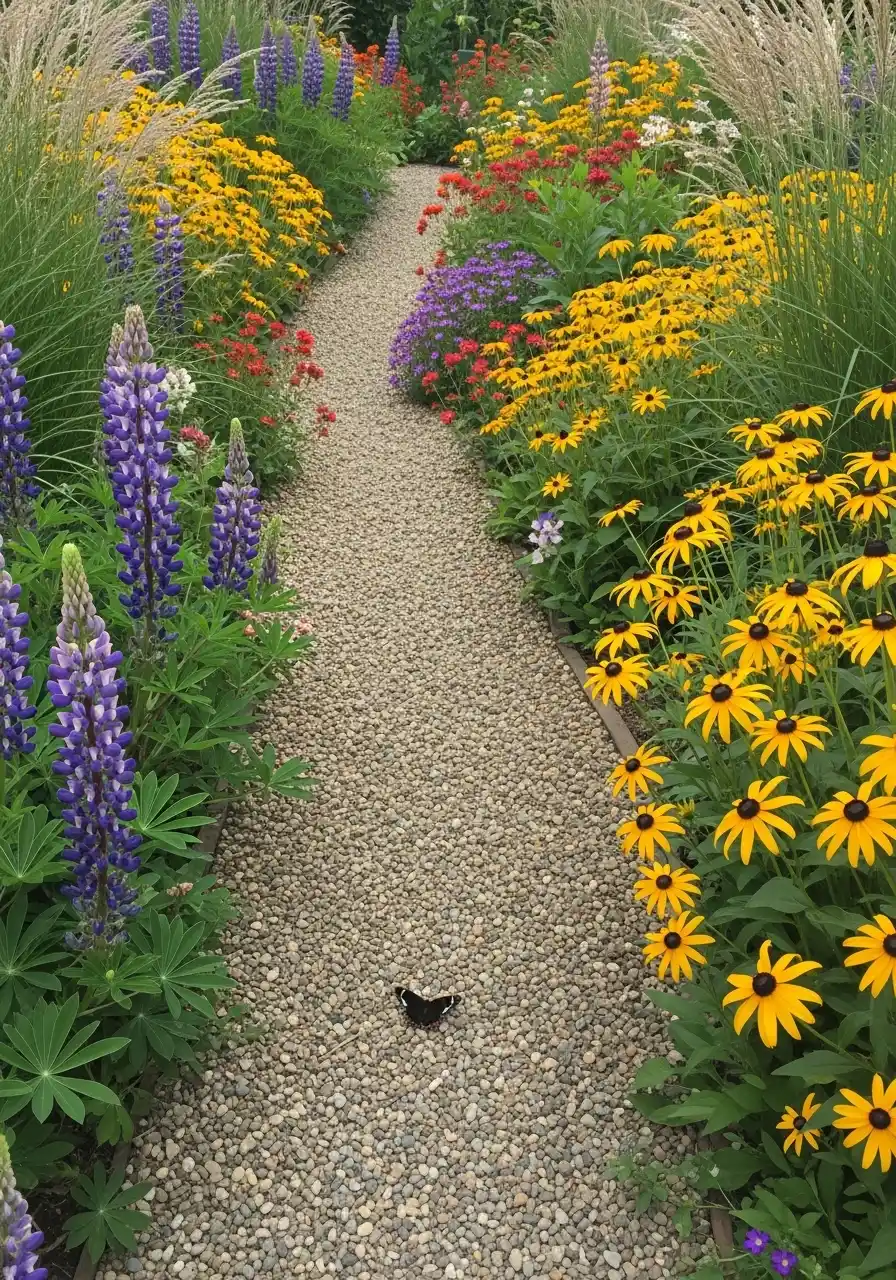
This one has a simple gravel path, then big repeating yellow blooms on both sides, plus grasses that sway. It feels airy and bright, and the repeats make it look designed. I really like this for wildflower border ideas because you can swap the plant types but keep the structure and it still works.
Start with the gravel path wide enough that two people can pass, if you can. Then anchor the border with a “repeat plant,” like black-eyed Susans, coreopsis, or rudbeckia. Repeat them every few feet. Add grasses in clumps to break it up and soften the edges. The grasses also keep things interesting when blooms fade.
A hack: put the tallest grasses where the path curves. They hide what’s ahead, so the walk feels longer. It’s a visual trick, but it’s a good one. Also, gravel needs edging, or it creeps into the bed like it owns the place.
Stone wall border with lavender haze and coneflower pops
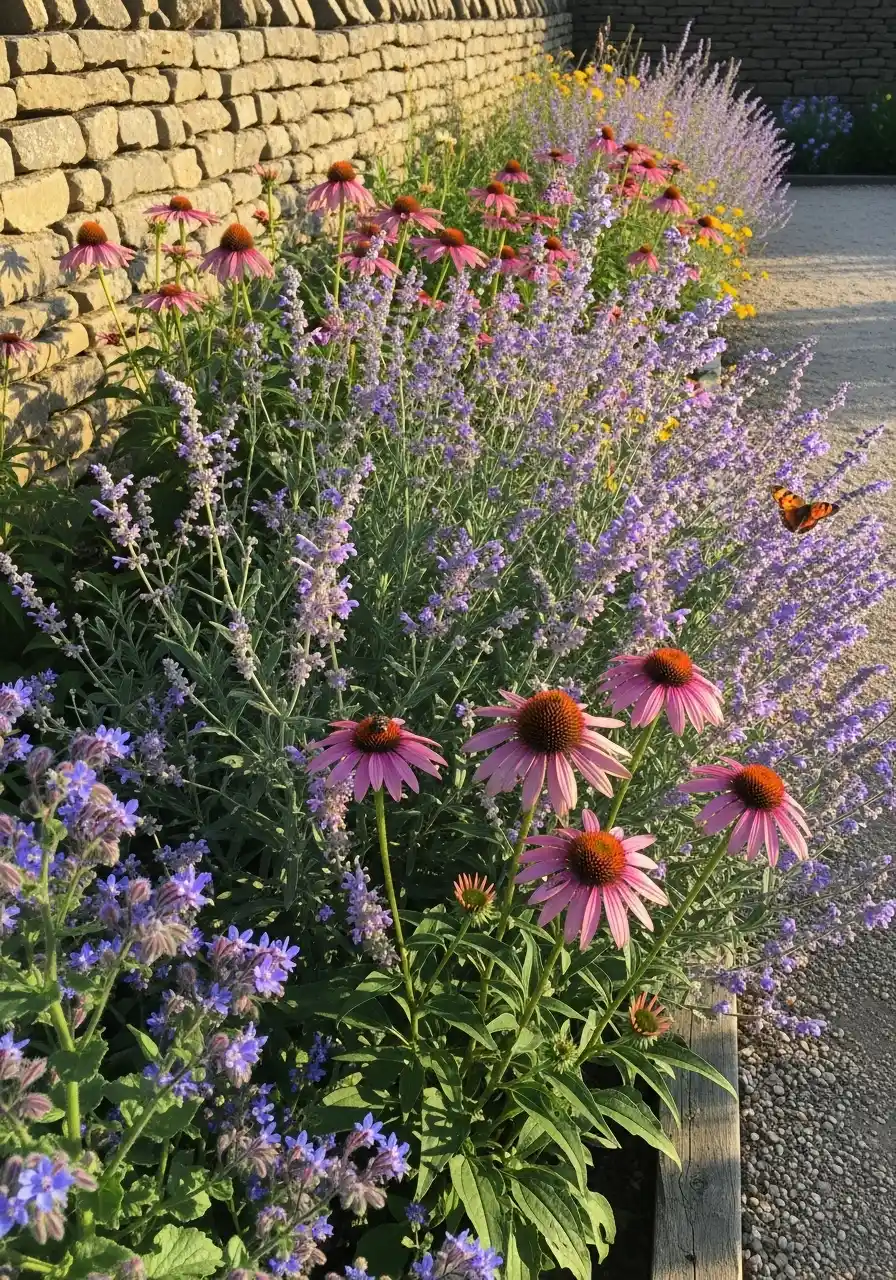
This border runs along a stone wall and it feels cozy and sunny. The purple “haze” (lavender or catmint vibe) makes a soft cloud, and the coneflowers pop above it like little fireworks. This is one of my favorite garden border wildflowers looks because it’s simple, calming, and still full of life.
To plant it, use a main “filler” plant that blooms for a long time. Catmint, salvia, or Russian sage can do that. Then add coneflowers in front or sprinkled through, but in groups, not scattered. The stone wall is doing background duty, so you don’t need 20 different flower types.
My tip: keep the front edge lower and the back edge taller. That’s it. When the front edge is too tall, the whole border looks heavy. And butterflies love this combo. I know that’s not a “design” thing, but it feels so good when you see them, like the garden is actually working.
Modern home border that still feels wild
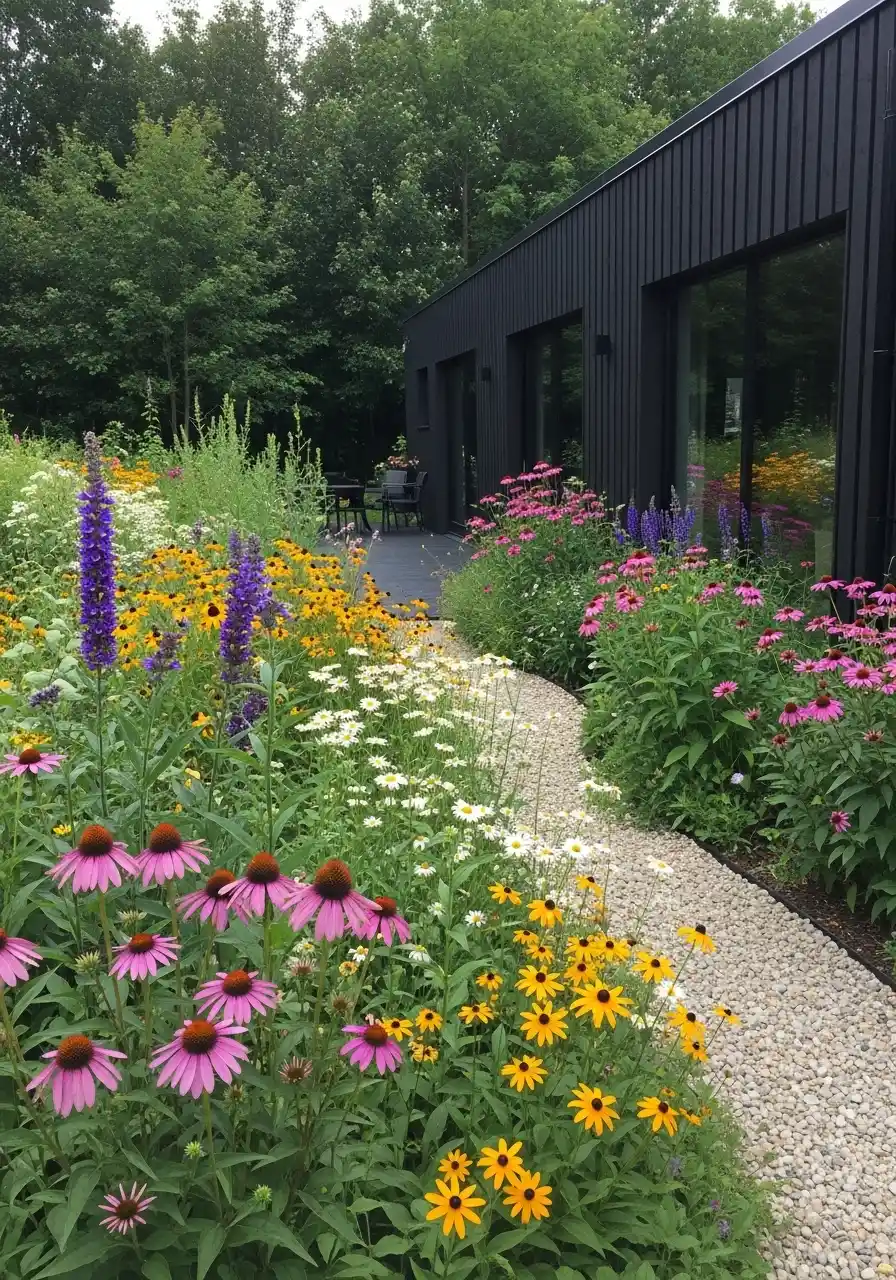
The black modern house makes the colors look even brighter. The border curves with a pale gravel path, and the planting is loose but not messy. I like this because it proves wildflower garden border ideas can work even with modern architecture. It’s not only for cottage yards.
To recreate it, pick a tight color palette. I see pink coneflowers, yellow daisies, and purple spikes repeating. Keep those three main colors, then add white daisies as a “breather.” Use gravel for the path so it looks clean and low-maintenance. Plant the flowers in thicker clumps near the path, and let taller ones rise closer to the house side.
Small hack: place your tallest plants where the windows reflect the garden. It doubles the effect. And yes, I do think about reflections too much. But when it works, it’s kinda stunning.
Big sweeping curve with a gazebo view
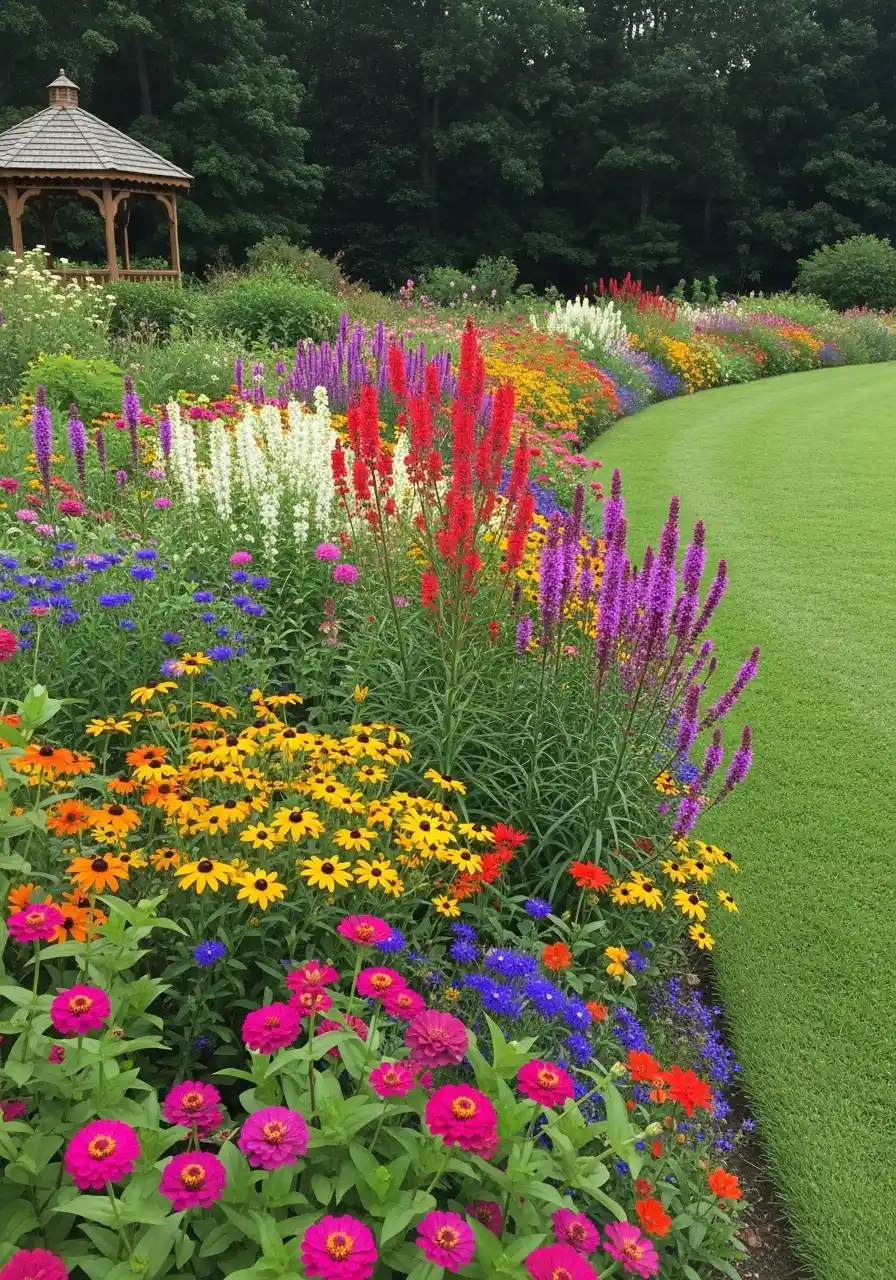
This border is the loudest one in the best way. It’s a long sweeping curve with layers of color, height, and texture, and the gazebo in the background makes it feel like a park. For wildflower garden borders, this is the “go big” version. It’s not shy, and it shouldn’t be.
To build something like this, start with the curve line and plan layers: low flowers in front, medium flowers in the middle, tall spires in the back. Use a few “hero plants” that repeat, like zinnias, salvias, and black-eyed Susans. Then fill gaps with smaller bloomers. The key is density. Bare soil ruins the illusion.
My honest take: this border looks expensive because it’s full. Fullness is the luxury. If you’re on a budget, plant smaller plugs closer together and be patient. Year two is where it starts to flex, not year one.
Backyard stepping stones with lights and quirky charm
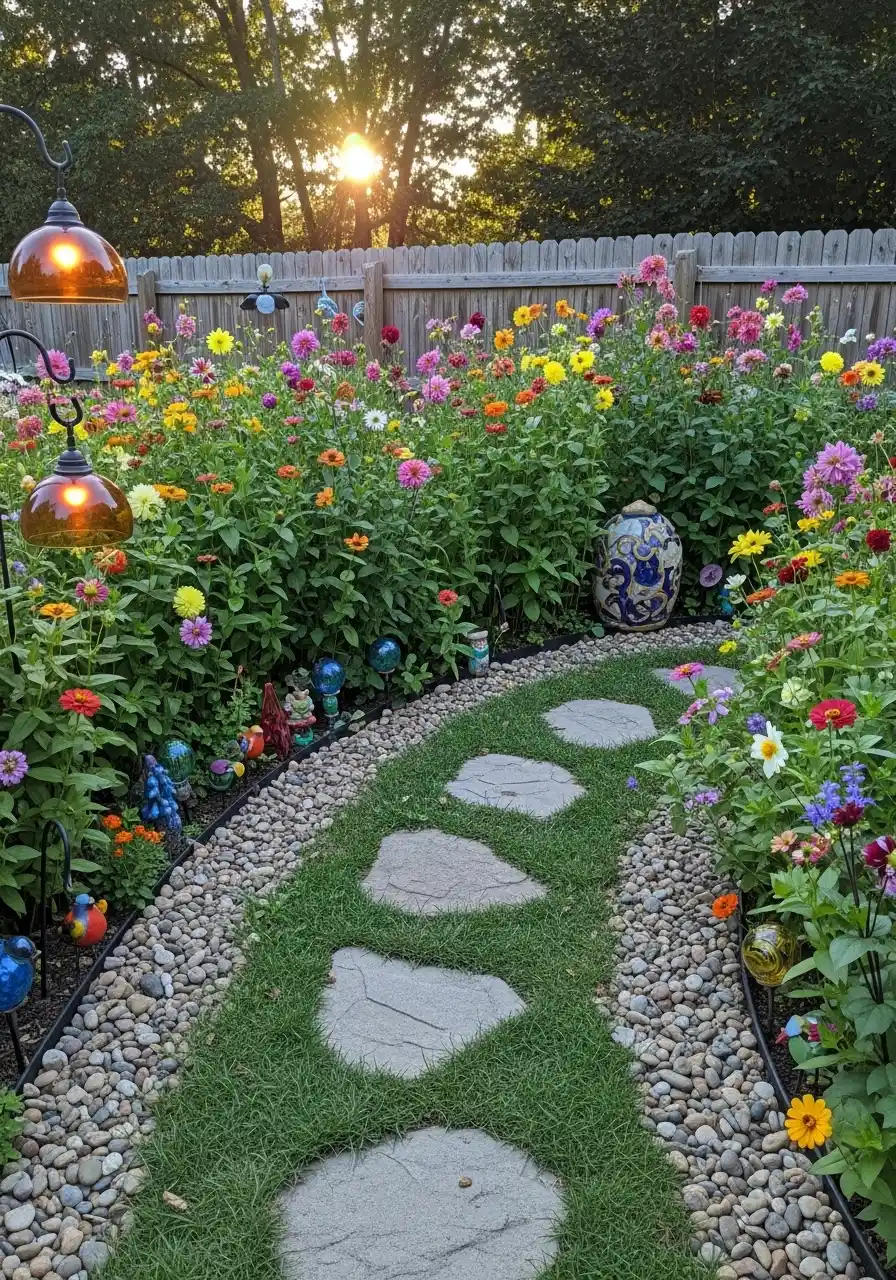
This next one feels like a happy little backyard party. There’s a stepping-stone path, pebble edging, garden lights, and a thick wildflower border on both sides. It’s not formal, it’s friendly. I love this style of wildflower garden border ideas because it invites you in. Like, you wanna walk it at sunset and just stand there for a minute.
To copy it, keep the path simple, stones in a line, and use pebbles as a neat frame. Then plant a mix of bloomers with different heights. Zinnias, cosmos, calendula, and asters work great, plus a few taller “anchors” near the fence. Add small garden decor if you want, but don’t overdo it. One or two pieces is charming. Ten pieces is chaos.
My tip: put lights low, aimed at the path, not blasting the flowers. Soft light makes everything feel cozy. And yeah, I’m a sucker for warm lighting, it makes even a messy border feel intentional.
Wildflower garden border ideas that feel like a path into a secret place
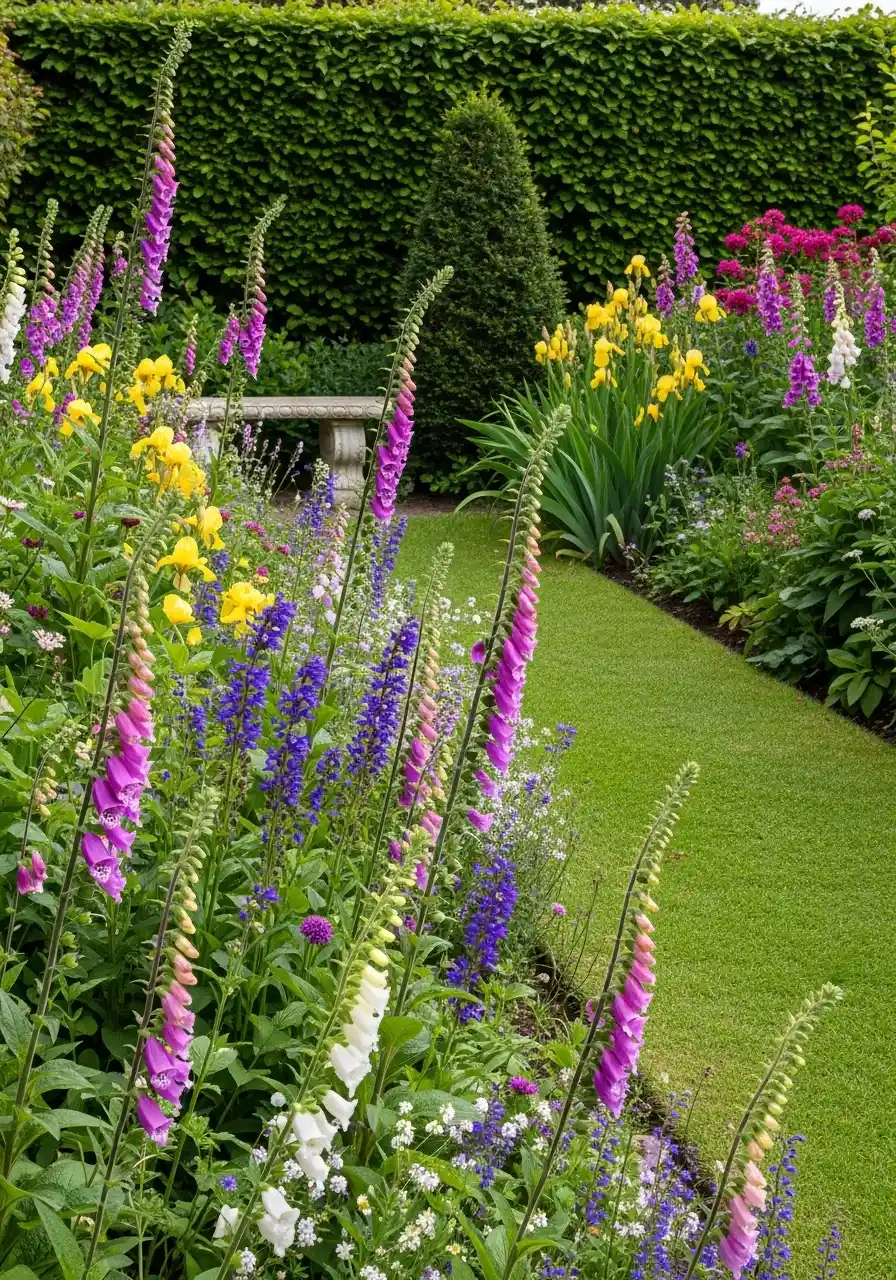
This border with tall foxgloves and pops of purple and yellow feels like a doorway. Like if I follow the curve, I’m gonna end up at some hidden bench where I can sit and pretend I have my life together. The hedge in the back makes everything feel safe and tucked in, and that helps the “wild” flowers look intentional instead of messy.
If you want wildflower garden border ideas like this, start with a strong background. A hedge, a fence, even a row of shrubs. Something steady. Then plant tall spires like foxglove, delphinium, or lupine toward the back and middle. The trick is to repeat them. Not one foxglove here and one there. Do little clusters so your eyes understand it.
I also notice the edge stays clean. That green path is tight and smooth, so the border can be crazy without looking sloppy. My hack is simple: keep one part “neat” on purpose. A mowed strip, a gravel path, or crisp edging. That neat line is what makes the wildflowers feel like a choice, not a mistake.
Fence line wildflower borders that use color blocks like a quilt
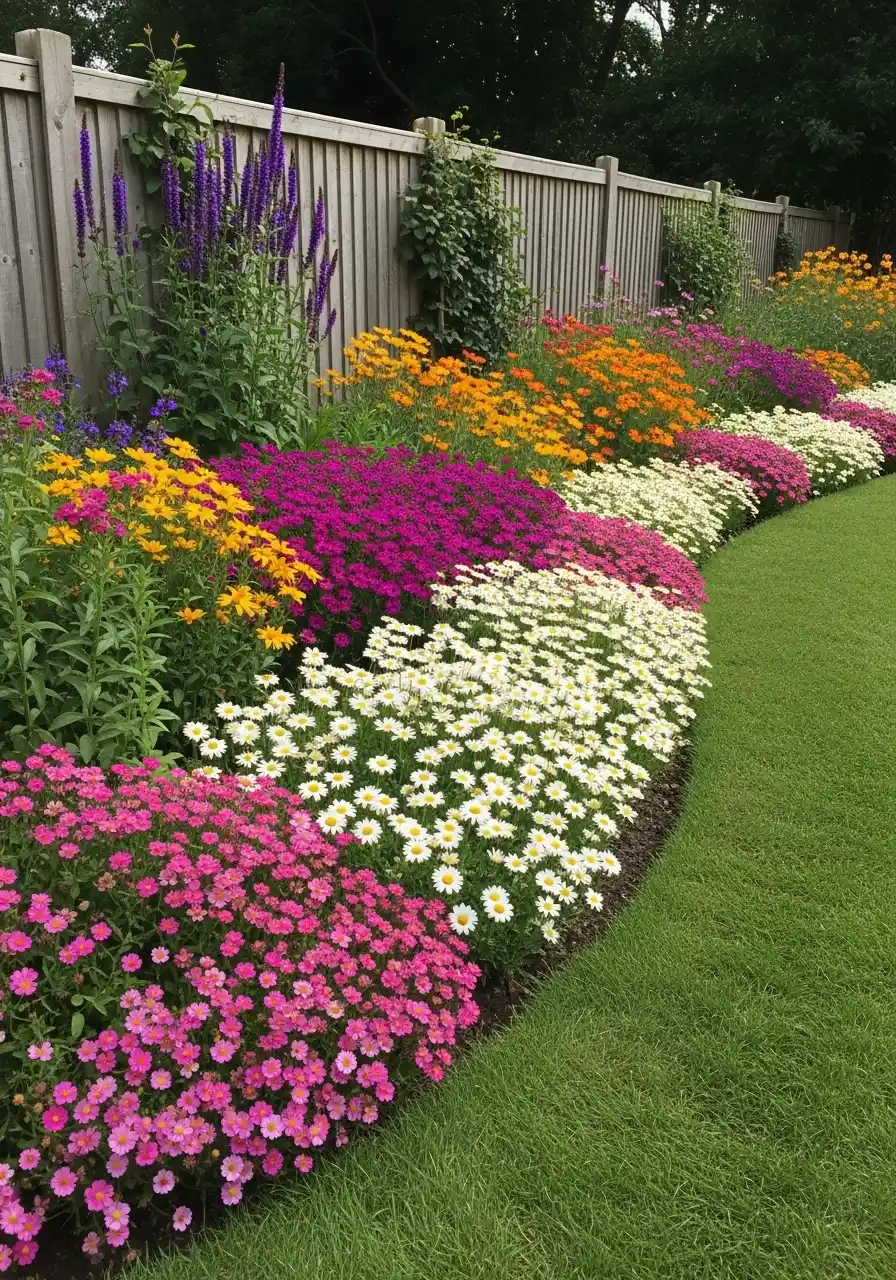
This fence border is loud, in the best way. It’s like a quilt made of flowers. Big patches of white daisies, then magenta, then orange, then purple. I’m not gonna lie, I used to think “blocks of color” would look too fake, but in a wildflower border it actually looks more natural. Like fields do that too sometimes, they clump.
For wildflower border ideas along a fence, I’d copy the layering. Tall purple spikes in the back, medium flowers in the middle, and lower mounding flowers at the front. The front edge is the money spot. If the front is pretty, the whole thing looks good even if the back gets a little messy.
A solid trick here is to pick a color plan before you plant. I never do that, and then I regret it later. Choose 3–5 main colors, then repeat them down the line. Also, leave space for plants to widen. Wildflower styles look best when plants can lean and touch each other a bit. Gaps make it look unfinished and kinda sad.
Sidewalk wildflower borders that lean and spill like they don’t care
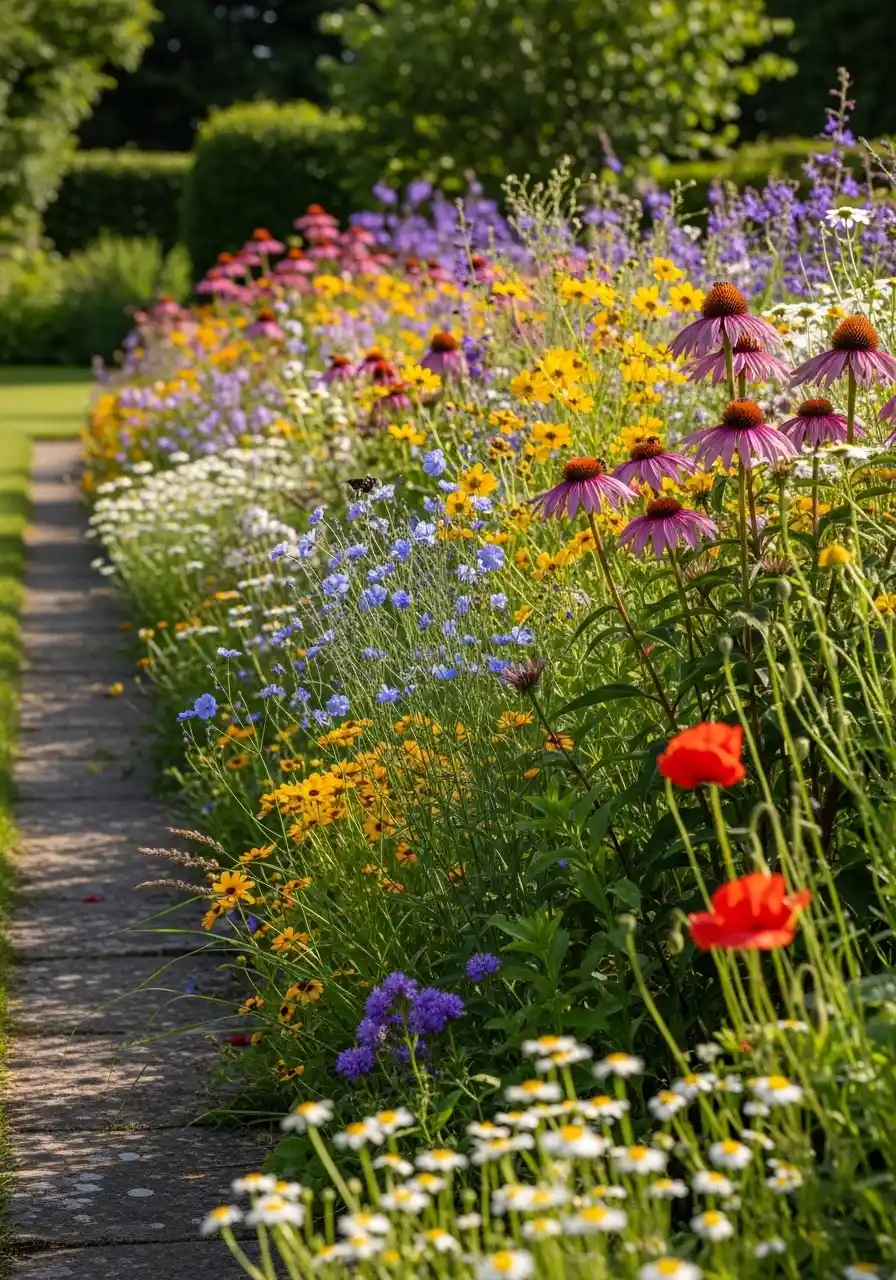
This border beside the sidewalk feels like it’s trying to kiss your ankles. Coneflowers, little blue flowers, white daisies, and warm yellows, all mixed like a big happy mess. And the sidewalk makes it even better, because it frames the chaos. I love that feeling, like you’re walking right beside a living rainbow.
If you’re trying wildflower garden border ideas for a walkway, plant taller stuff a little farther back, and let smaller plants spill forward. Use plants that don’t mind being close. Coreopsis, coneflower, black-eyed Susan, asters, and yarrow all do great. And throw in some airy fillers like baby’s breath or gaura, because they make everything feel softer and less stiff.
My honest opinion: this style looks “wild” but it needs a little editing. I’d deadhead some flowers and cut back the ones that flop into the path too hard. Wild is cute until you’re tripping over it. A little trim once a week keeps it pretty, and it still feels natural.
Curved bed wildflower borders with a low fence to stop the chaos
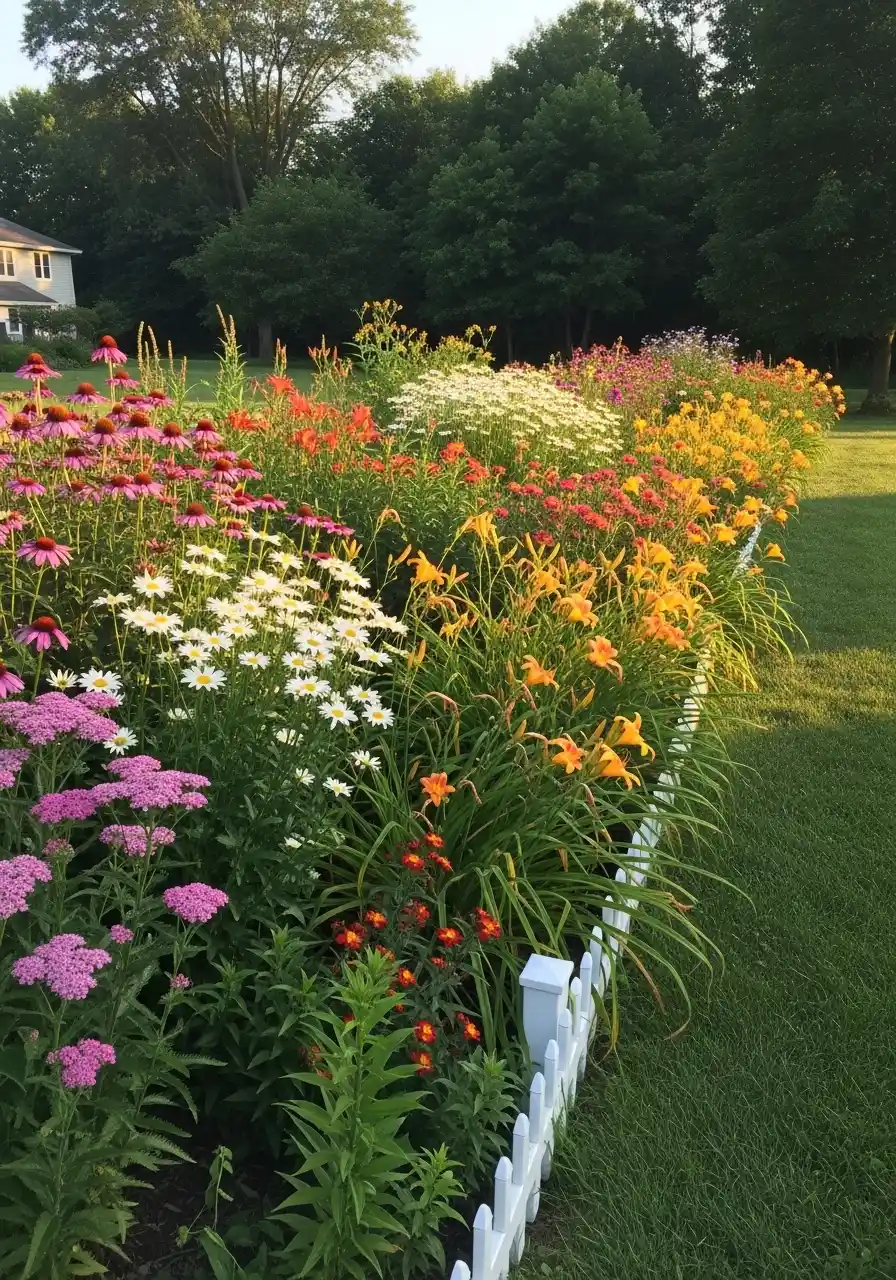
The long curved bed with the tiny white picket edge is such a smart move. It keeps the wild mix from swallowing the lawn. You still get that meadow vibe with daisies, lilies, and bright bursts, but the fence says, “this is on purpose.” I like that because sometimes my yard needs boundaries, and honestly so do I.
For wildflower garden edging ideas, a short border like this works really well. It doesn’t have to be a fence. It could be brick, stone, or even a clean trench edge. The key is keeping a clear line between the wildflower bed and the grass. When your grass creeps in, it ruins the look fast.
Also, go heavy on repeats. I see repeated colors and repeated shapes. That’s why it looks so full and not confusing. If you plant one of everything, it turns into chaos soup. Repeating the same flower in drifts makes the wildflower border feel calm, even when it’s bursting.
Cottage-style wildflower borders that mix textures like a painting
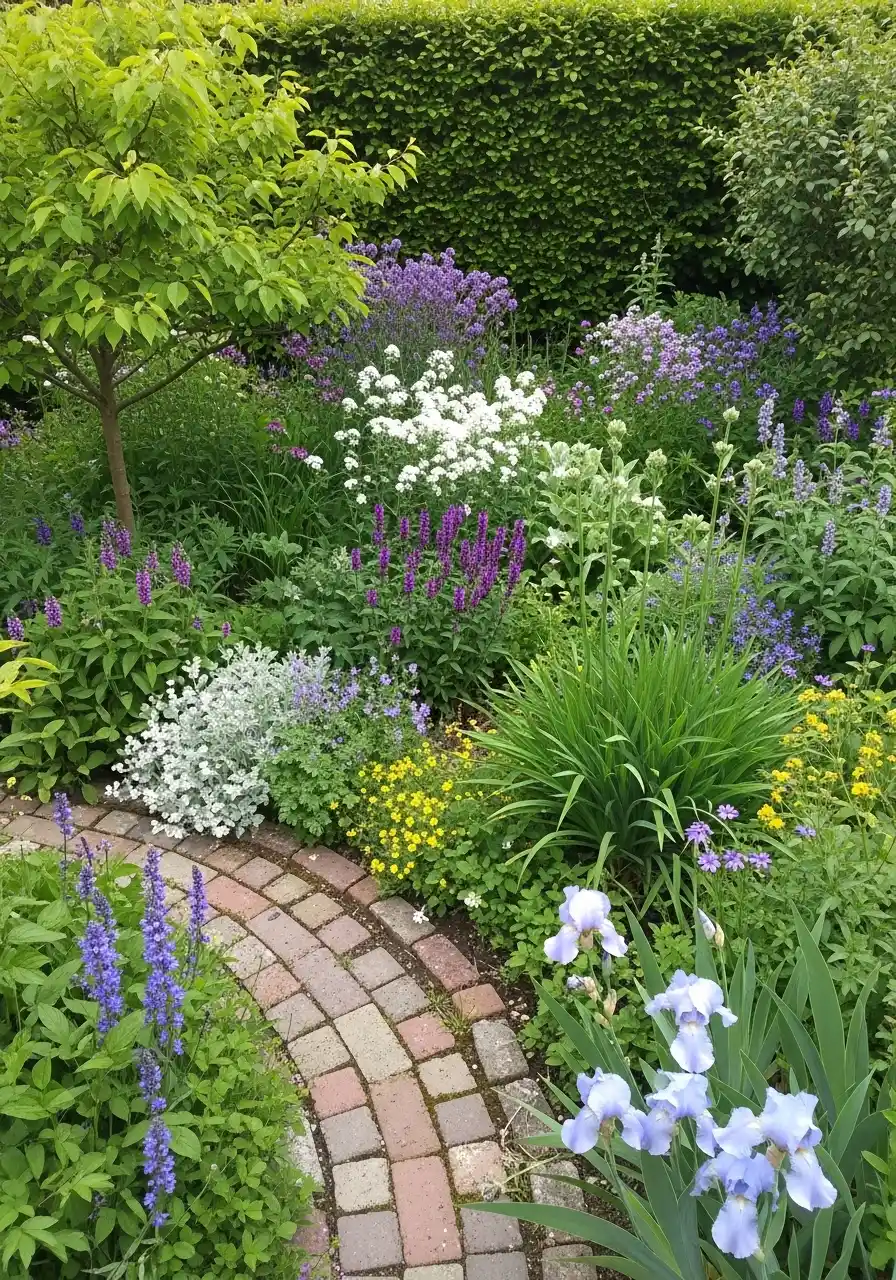
This one feels softer and more “garden-ish,” not a full meadow, but still wildflower vibes. There’s a brick path, and plants in layers, and a mix of purple, white, and yellow. It’s cozy. Like a place where you’d drink iced tea and pretend you don’t have emails waiting.
If you like wildflower garden border ideas that feel cottage-y, focus on texture. Mix spiky flowers (salvia, veronica) with fluffy ones (yarrow, queen anne’s lace) and mounding ones (catmint, geranium). It’s not just about color, it’s the shapes. Shapes are what make the border look rich even if flowers aren’t blooming yet.
A little hack: use paths to break up the space. The brick curve makes it feel designed. Even a cheap gravel curve can do that. Paths also help you weed and deadhead without stepping into plants like a clumsy giant.
Gravel-path wildflower borders with purple-and-white rhythm
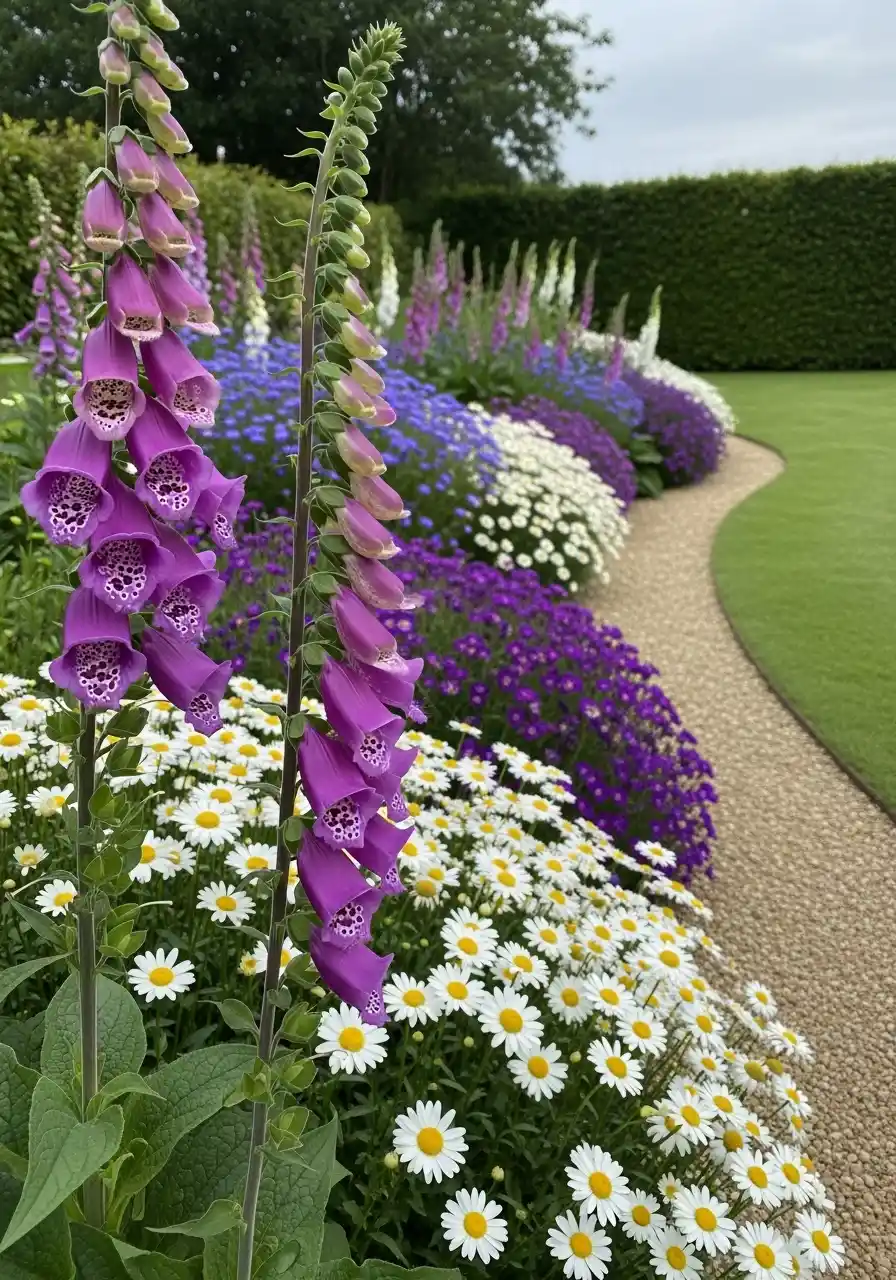
This border with the gravel path and strong purple and white bands feels super clean, even though it’s still wildflower-ish. Foxgloves stand tall like little guards, and daisies make a thick front edge. It’s basically a neat wildflower border, which sounds like a contradiction but it works.
For wildflower border garden ideas like this, stick to a limited palette. Purple, white, maybe one extra accent color. When the palette is tight, the plants can be full and it won’t look messy. This style is perfect if you like wildflowers but you also like order.
The trick is maintenance, and I’m not gonna lie, this one needs it. Daisies spread, foxgloves drop seed, and you’ll get volunteers everywhere. But that’s also the fun part. My suggestion is to pull seedlings where you don’t want them and keep the path edge trimmed. Don’t try to control everything. Control like 70% and let the rest do its thing.
Stone-step wildflower paths with tall grasses for that windy “meadow” feel
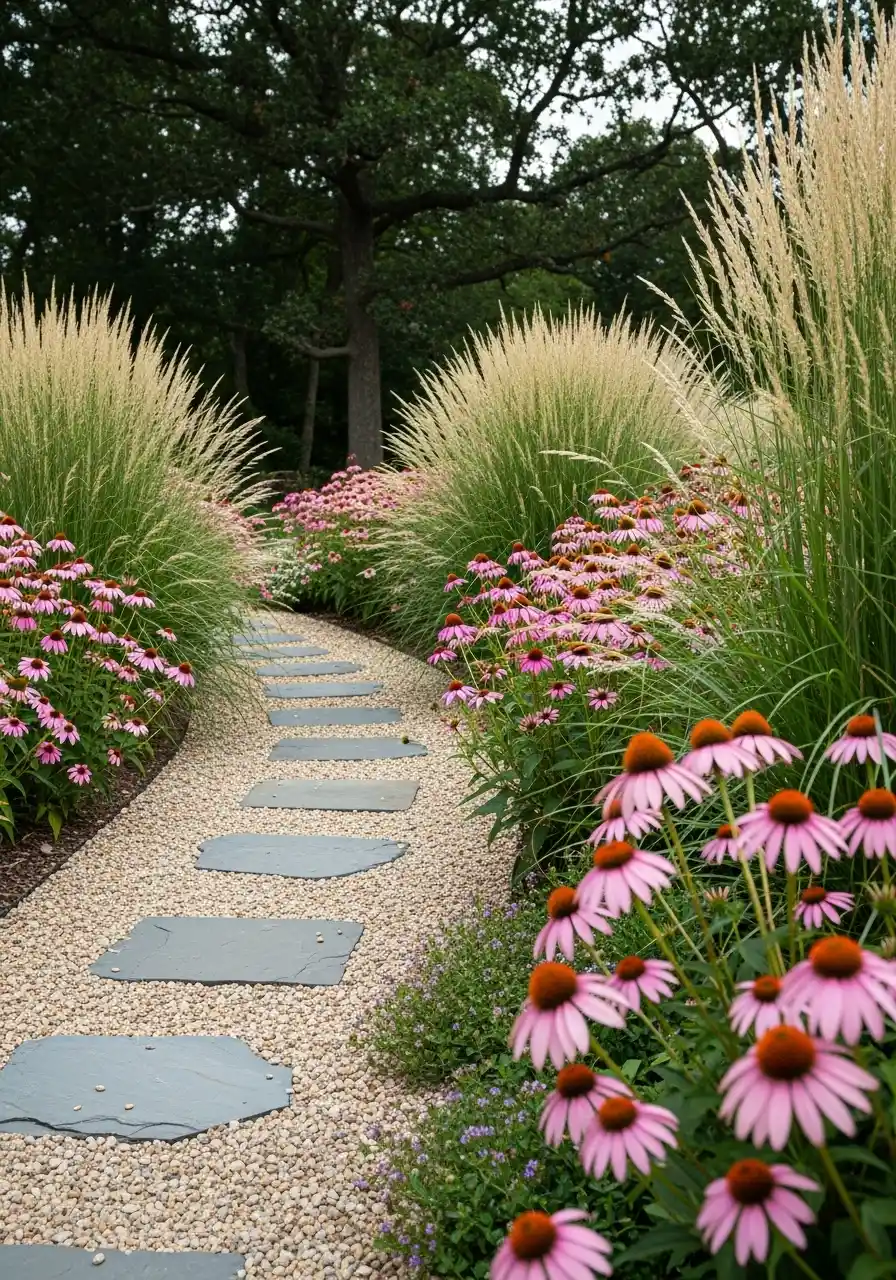
This stepping-stone path through tall ornamental grass and coneflowers is straight up dreamy. It looks like wind lives there. The grass makes movement, and the coneflowers add color without being too loud. I also like how the stepping stones slow you down. It forces you to walk like you’re paying attention.
For wildflower garden border ideas that feel like a meadow path, use grasses as the main structure. Switchgrass, feather reed grass, little bluestem, even fountain grass depending on your zone. Then add wildflowers in pockets: coneflower, rudbeckia, bee balm, and asters. The grasses hold the shape so the wildflowers can party.
My hack is spacing the stones wide enough so you’re not stepping on plants. People always cram them too close and then it looks weird. Leave room, and plant low groundcover between stones if you want it softer. Also, trim grasses in late winter so they come back fresh.
Playful wildflower borders with lanterns that make it feel personal
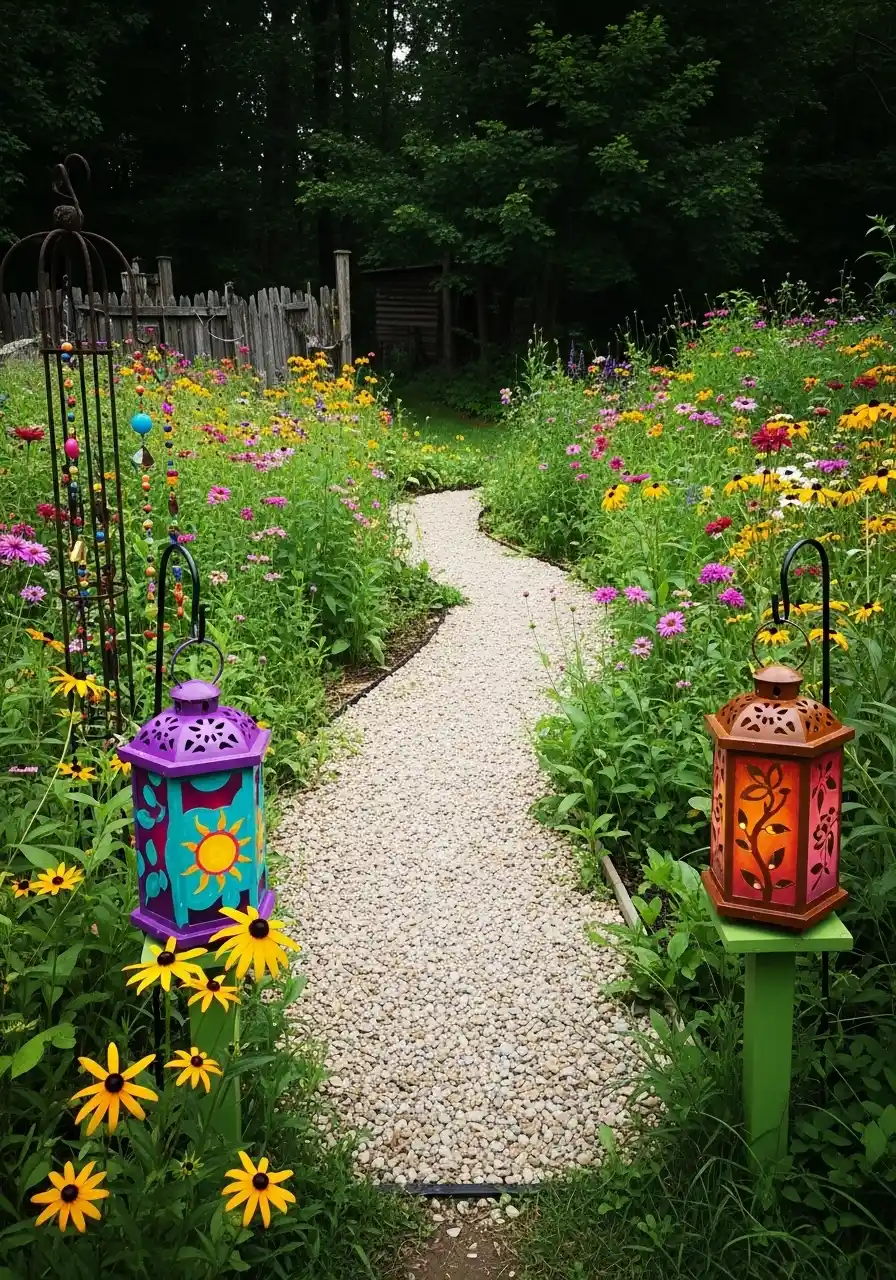
This last one is the most “real human” border to me. It’s wildflowers on both sides of a gravel path, but then there’s lanterns and colorful stuff, and it feels like somebody actually lives there. Not just a perfect garden for photos. I like that a lot, because perfect gardens can feel kind of cold.
For wildflower garden border ideas with personality, add one or two fun features. Lanterns, a bird bath, a quirky trellis, a bench, whatever. That little detail makes the border feel like your space, not a copy of someone else’s. And it gives your eyes a place to rest in all the flower chaos.
The practical trick here is using a simple path. Gravel is forgiving. If plants flop, you can trim them back. If weeds show up, you can pull them fast. And if you want the border to look full, plant thick at the edge. Most people plant too thin. Thick edges make wildflower borders look finished.
FAQ about wildflower garden border ideas
-
What are the easiest wildflower garden border ideas for beginners?
-
How wide should a wildflower garden border be?
-
Do wildflower borders need full sun to look good?
-
How do I keep wildflower border ideas from looking messy?
-
What flowers bloom the longest in wildflower garden borders?
-
Can I mix perennials and annuals in garden border wildflowers?
-
How do I control weeds in a wildflower border garden?
-
What is the best edging for wildflower garden border ideas?
-
How often should I water a new wildflower border?
-
Can I plant wildflower garden borders along a fence?
-
How do I make a wildflower border attract butterflies?
-
What’s the best way to plan color in wildflower border ideas?
-
Should I mulch wildflower garden borders or leave bare soil?
Conclusion
These wildflower garden border ideas all have one thing in common: they guide your eyes. Curves, paths, repeats, and layers do the heavy lifting, then the flowers bring the emotion. I like borders that feel alive but still a little controlled, and your photos hit that sweet spot. If you copy just one layout from these and repeat a few plants, your border will look “planned” even if you feel like you’re guessing half the time. Honestly, I’m guessing too, just with more mulch on my shoes.