The first time I saw food forest garden ideas, I didn’t even know what I was looking at. It just looked like a messy orchard that somehow fed people. Then I noticed the paths, the layers, the berries tucked under the trees, and I got that weird jealous feeling like, “wait… your yard gives you snacks??” I’m not proud of how fast I fell into this rabbit hole, but here we are.
These 15 images feel like real food forest garden ideas you can copy, not just pretty pictures. They’ve got fruit trees overhead, herbs and greens underneath, wood chip paths, and little “rest spots” that make it feel like a place, not just a growing zone. I’m gonna walk through each design like I’m standing there with a basket, trying not to trip over squash vines.
Table of Contents
Food forest garden ideas with an orchard entry path and a “destination bench”
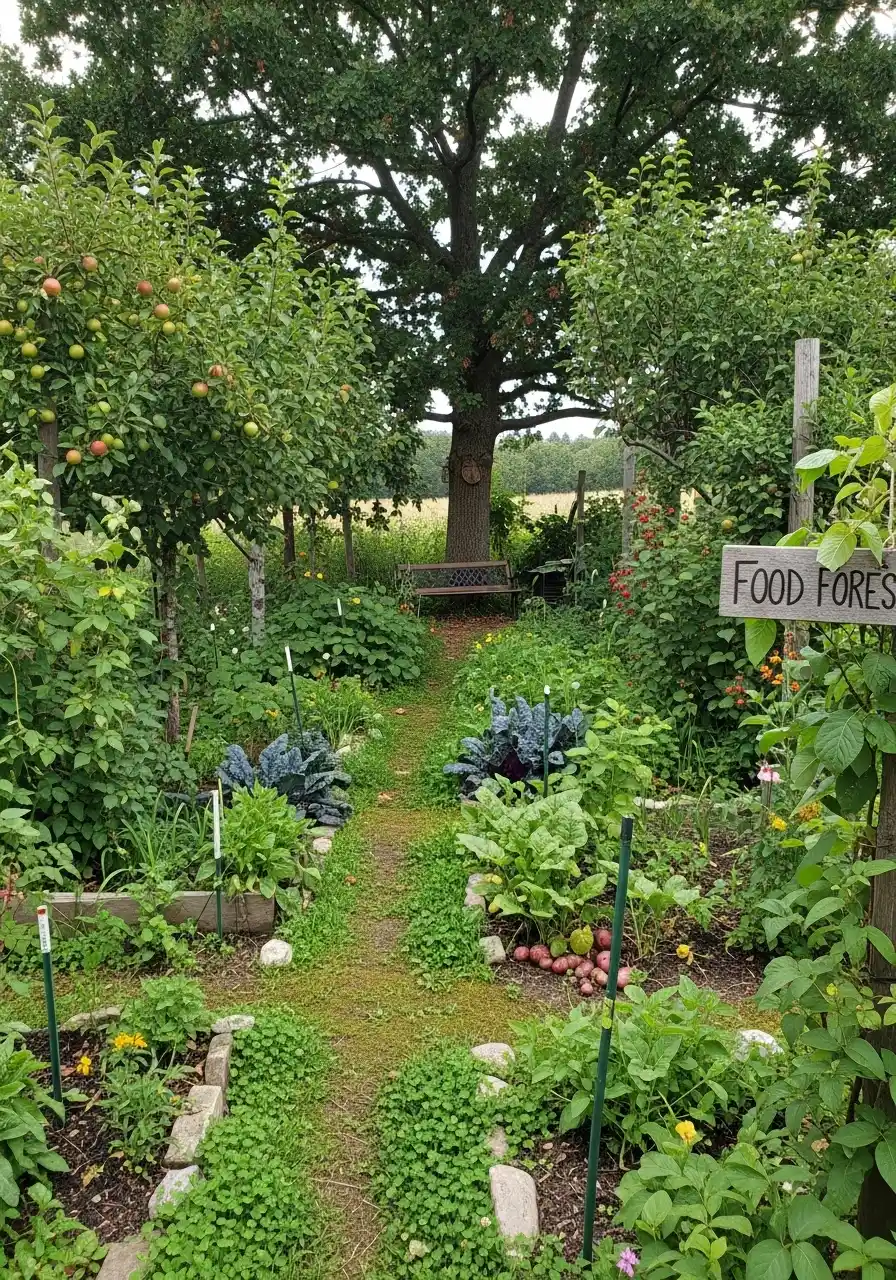
This first setup feels like a storybook. There’s a narrow path leading straight to a bench under a big old tree, and fruit trees on both sides like a welcoming tunnel. Plus there’s literally a sign that says “Food Forest,” which I kinda love because it’s bold. It makes the space feel official, like yep this is a real system, not just random plants.
If you want food forest garden ideas that feel inviting, steal the “destination” trick. Put something at the end of the path: a bench, a bird bath, even a big pot. It gives you a reason to walk in. And the path here looks simple, mostly grass or compact soil, edged loosely with stones. That’s smart because it’s forgiving. You don’t have to be perfect.
I also notice mixed plants under the trees. Leafy greens, herbs, maybe potatoes or squash, plus little flowers tucked in. That layered look is the whole food forest vibe. You’re using the shade under fruit trees instead of treating it like wasted space.
Food forest garden ideas with wood chip paths and apple trees as the “ceiling”
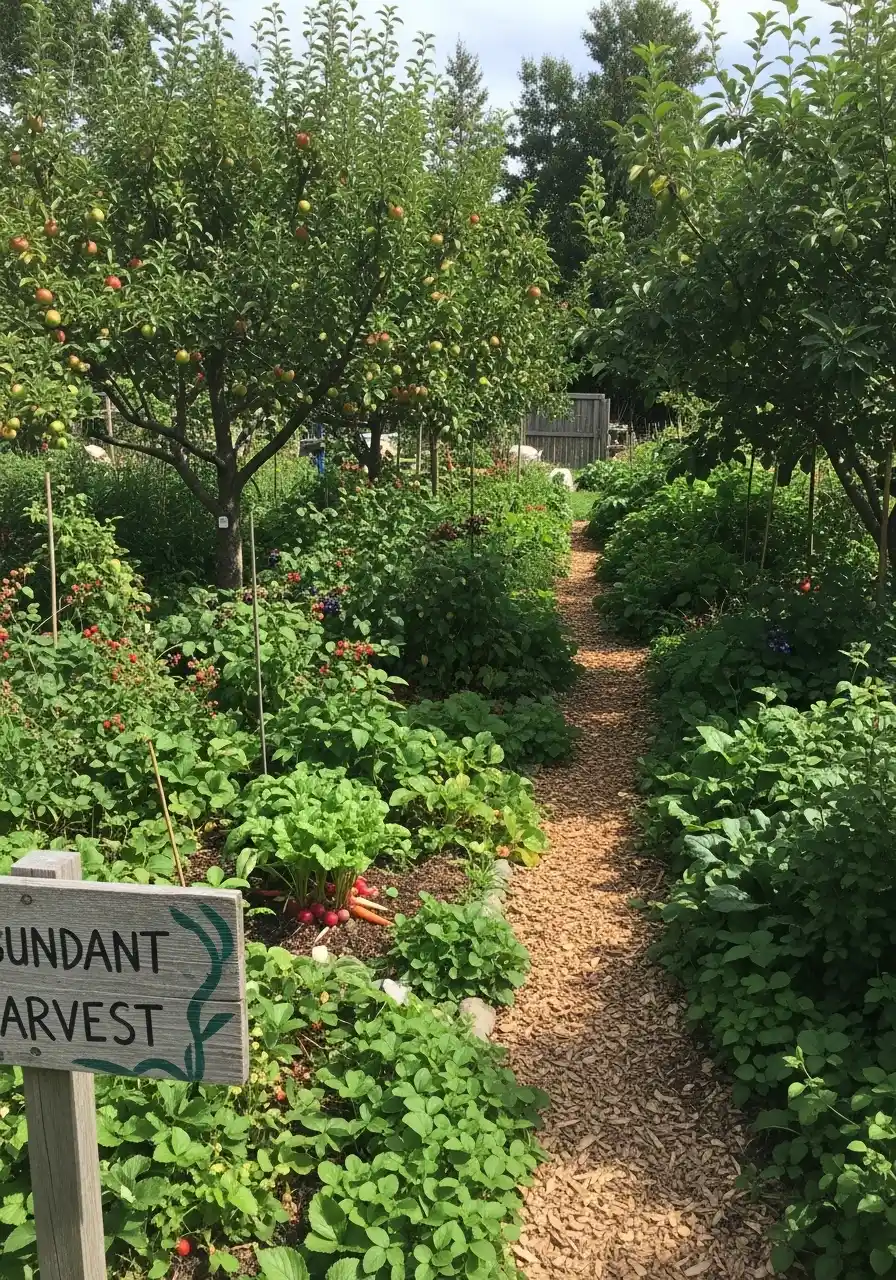
This one is the classic orchard lane. Apple trees overhead, thick plants on both sides, and a clean wood chip path down the center. It looks lush but still walkable, which is honestly the hardest part. Lush is easy. Walkable is the challenge.
Wood chips are a cheat code for food forest garden ideas because they keep weeds down and make the garden feel organized fast. But you have to commit to topping them up. If you don’t, the path gets thin and weeds start popping up like they own the place. I’d lay cardboard first, then dump chips thick, like 4 inches. It looks rough for one day, then it looks amazing.
Also, under those apple trees, the planting feels dense but not totally wild. That’s important. Leave pockets of space so you can harvest without wrestling branches and nettles. Food forests should feel friendly, not like a jungle that’s mad at you.
Food forest garden ideas with a narrow winding path and “soft chaos” planting
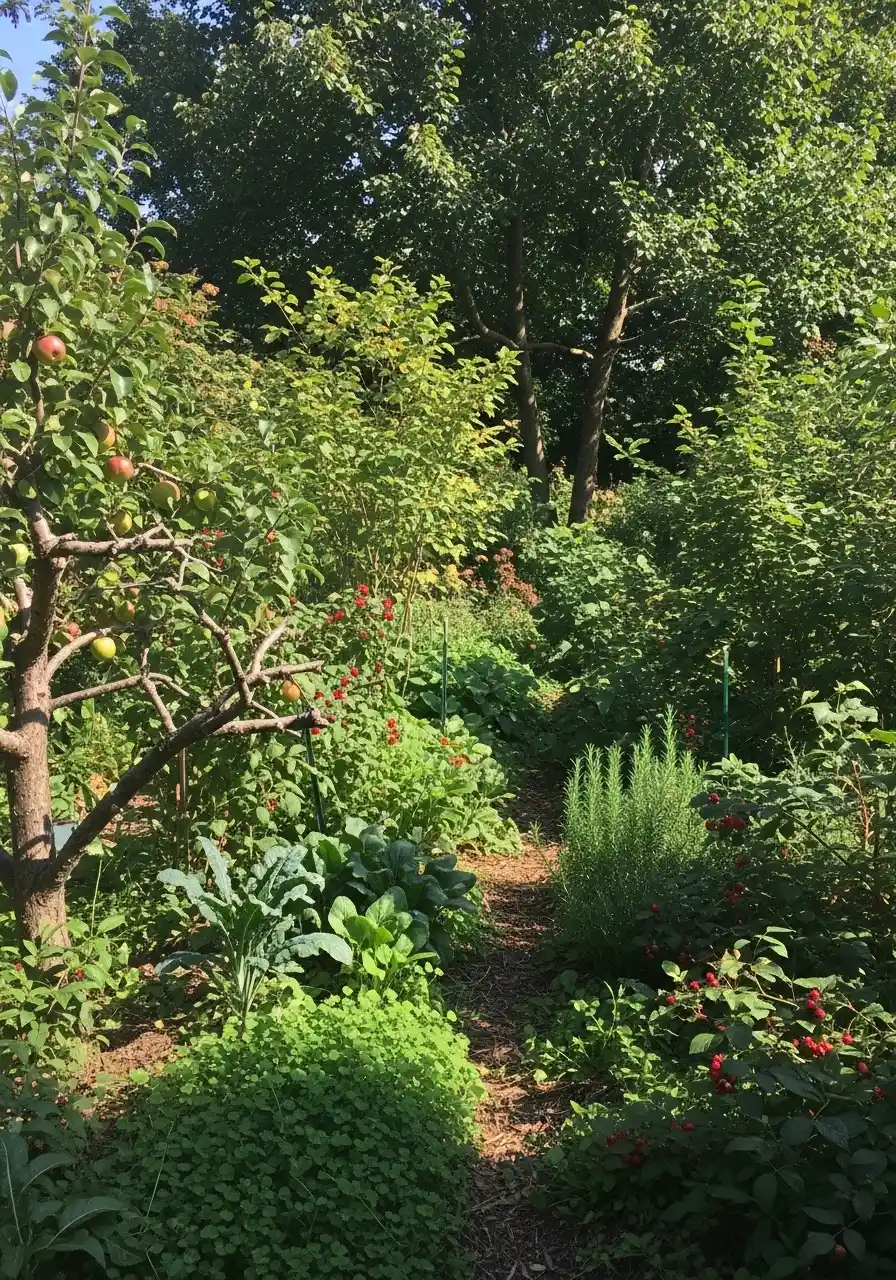
This image feels more wild, like you’re wandering through a living pantry. The path curves and disappears, and there’s a mix of shrubs, herbs, berries, and greens all layered together. I can see apple branches, berry canes, and a rosemary-looking shrub standing tall like it’s guarding the lane.
If you want food forest garden ideas that feel natural, focus on layers instead of rows. Put fruit trees first, then add berry shrubs (raspberry, currant, blueberry if your soil works), then herbs and groundcovers. The path can be simple mulch or chips. It doesn’t need fancy edging. It just needs to be clear enough that your feet know where to go.
My confession is this style looks easy, but it’s not “no work.” You’ll prune, thin, and chop plants back or the path disappears. The trick is seasonal maintenance. A few times a year, you trim edges, chop and drop plant material, and suddenly it stays usable without constant babysitting.
Food forest garden ideas with pumpkin vines and simple trellises along a chip path
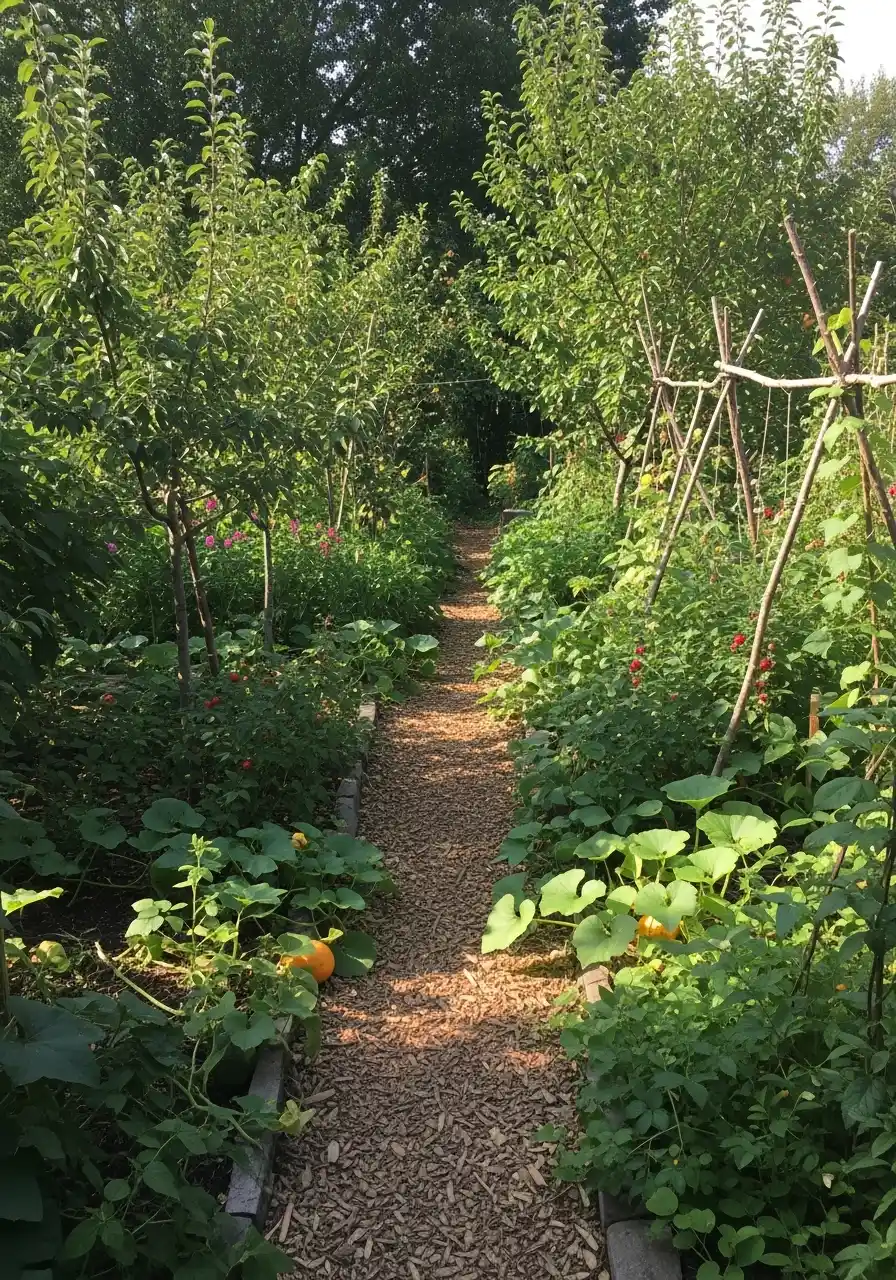
This one feels like a working garden tucked inside an orchard. The path is wood chips again, and on both sides you’ve got vines, squash, and plants climbing up simple stick trellises. It’s not fancy, but it works. I love that. The trellises look like they were made from branches, like you just used what you had.
If you’re trying food forest garden ideas on a budget, this is it. Use natural poles, twine, and basic frames. Grow beans, peas, cucumbers, or even small squash if you support them well. The benefit of trellising is you get food up off the ground, which helps with rot and makes harvesting easier.
Also, look at the spacing. The plants are thick, but the path is wide enough to walk through. That’s the secret sauce. Keep paths wide enough for your body and your basket. If you make paths skinny, you will brush plants, knock fruit off, and get annoyed. I know because I would.
Food forest garden ideas with a spiral-like orchard bed and a harvest basket moment
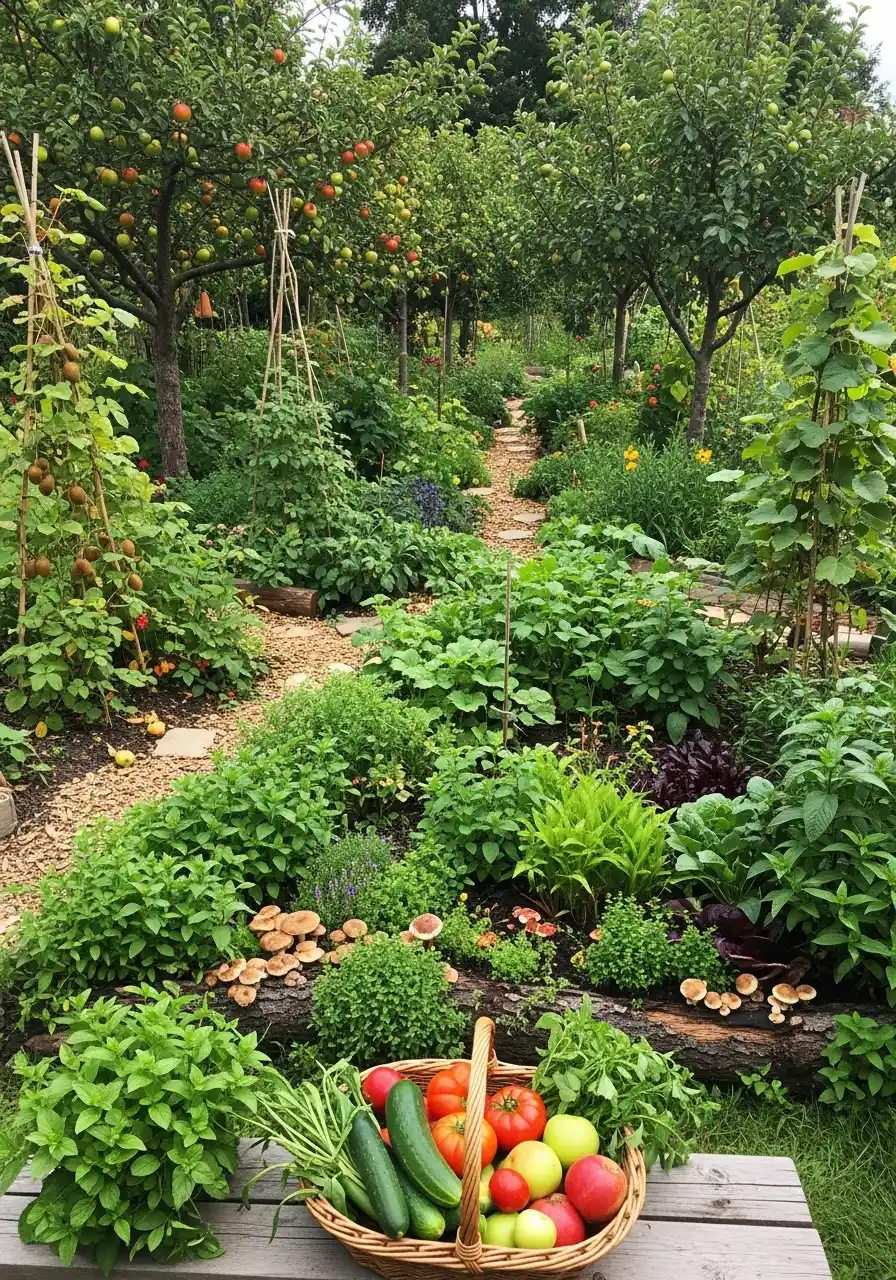
This one has the most “reward energy.” There’s a little basket full of tomatoes, apples, cucumbers, plus herbs spread out like a brag. And honestly yes, bragging is allowed. The garden itself looks like orchard rows with pathways weaving through, and mushrooms growing on a log is such a cool detail. It screams healthy soil.
A strong food forest garden idea here is mixing edible herbs at the edges. Mint, basil, thyme, oregano, chives, they make the whole place smell like dinner. And herbs flower, which pulls pollinators. So it’s pretty and useful. My favorite combo is basil near tomatoes, because it feels like the garden is making a recipe.
Also, mushrooms on a log is such a nerdy win. If you want, you can inoculate logs with mushroom plugs (like oyster mushrooms) and place them in shaded areas. It’s not instant, but when it works, it feels like magic.
Food forest garden ideas with berry bushes and ground covers (the “low layer” focus)
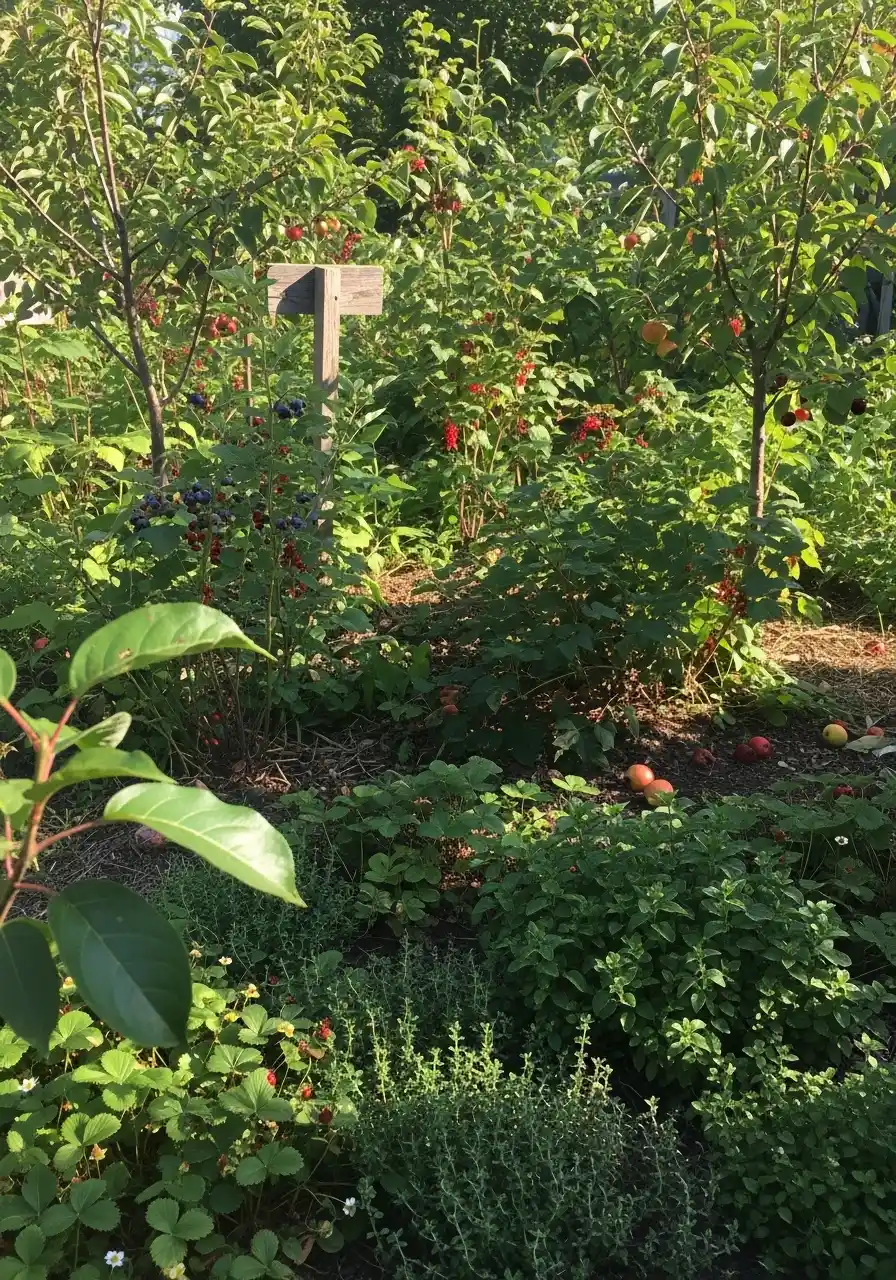
This scene feels softer and more “forest floor.” There are berry bushes and small fruit trees, and the ground is covered in low plants, maybe strawberries, thyme, clover, or other spreading greens. That ground layer is what makes a food forest feel like a real ecosystem.
If you’re starting food forest garden ideas, don’t skip groundcovers. Bare soil is basically an invitation for weeds. Groundcovers keep moisture in and protect soil life. Strawberries are a favorite because you get fruit and a living mulch. But be careful, strawberries spread. That can be good or annoying depending on your mood.
I also notice there’s still open space between plants, not everything is jammed in. That matters because air flow keeps diseases down, especially in fruit trees. Food forest does not mean “stuff everything.” It means “layer intentionally.”
Food forest garden ideas with a central hub garden and wood chip “rooms”
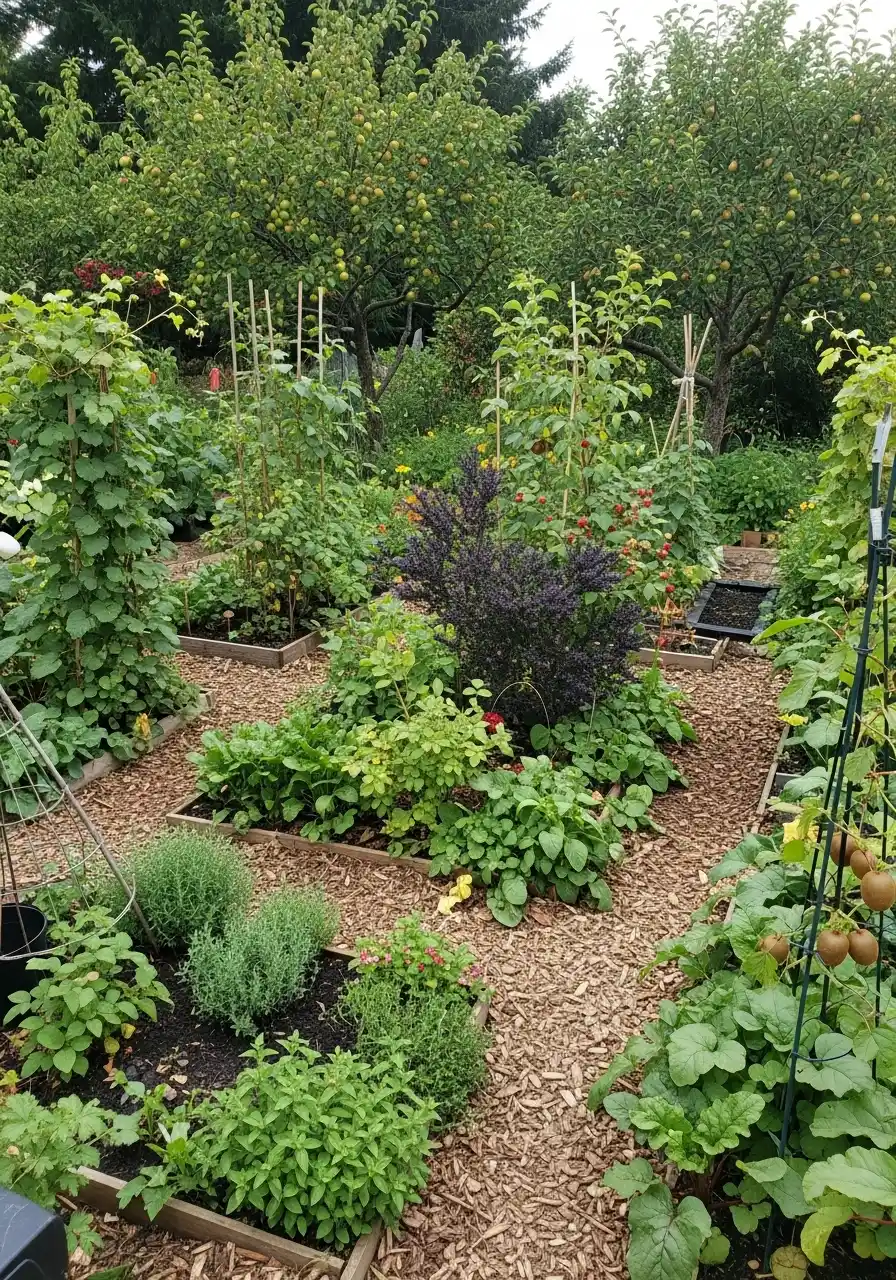
This one looks like a little garden village. There are beds divided by wood chip paths, and a central shrub or tree acting like a centerpiece. Everything feels arranged into “rooms,” which makes it less overwhelming. I really like that because food forests can look chaotic if you don’t give them shape.
A good food forest garden idea is to build a central hub path that branches out. You can do a main path, then smaller paths to different zones: berries, herbs, compost, annual veggie beds. That way you don’t wander around confused. Confused equals neglected. That’s just real life.
Also, planting herbs and low plants near the path edges is smart. You’ll brush them, smell them, maybe snack a little. It makes the garden interactive. The garden shouldn’t be a museum. It should be a snacky place.
Food forest garden ideas with a single statement tree and an understory flower ring
This orchard scene has one big fruit tree with a ring of orange flowers around the base, like a little halo. It looks so intentional, and it’s practical too. Flowers under trees can attract pollinators and beneficial insects, plus they make the tree area look cared for.
If you want easy food forest garden ideas that look pretty, do a “tree guild.” That means a fruit tree plus a circle of support plants. You can use nasturtiums, calendula, marigolds, comfrey, chives, garlic, whatever fits your climate. Some people use comfrey as chop-and-drop mulch because it grows huge and you can cut it back for leaf fertilizer.
The path here is wood chips again, and I’m not mad about it. Wood chips are just so good in a food forest. They keep your shoes clean and your brain calm.
Food forest garden ideas with a grape arbor and shaded walkway
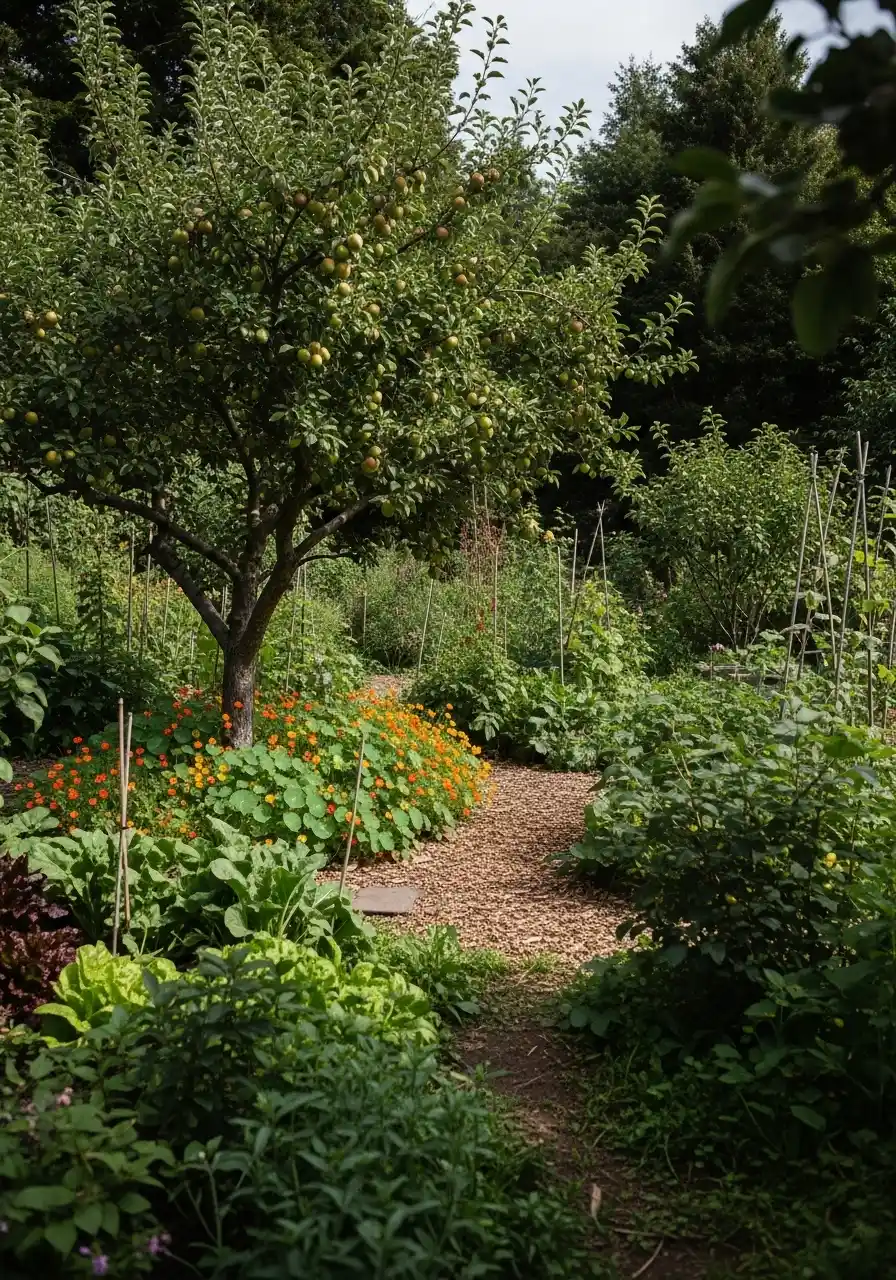
This one has a little grape structure or vine-covered frame, plus a narrow path running through. It feels like a garden tunnel without being too fancy. Vines overhead are such a strong food forest trick because you’re using vertical space like crazy.
If you want this idea, build the structure strong. Grapes get heavy. So do hardy kiwi. Don’t use flimsy posts unless you like rebuilding things every year. Also keep the path underneath gravel or chips, because fallen fruit and leaves are easier to clean up. Grass under grape vines turns into a sticky mess.
This is one of those food forest garden ideas that makes you want to walk out there just to feel the shade and the quiet. It turns your garden into a place you hang out, not just work.
Food forest garden ideas with mixed understory veggies, herbs, and a long orchard lane
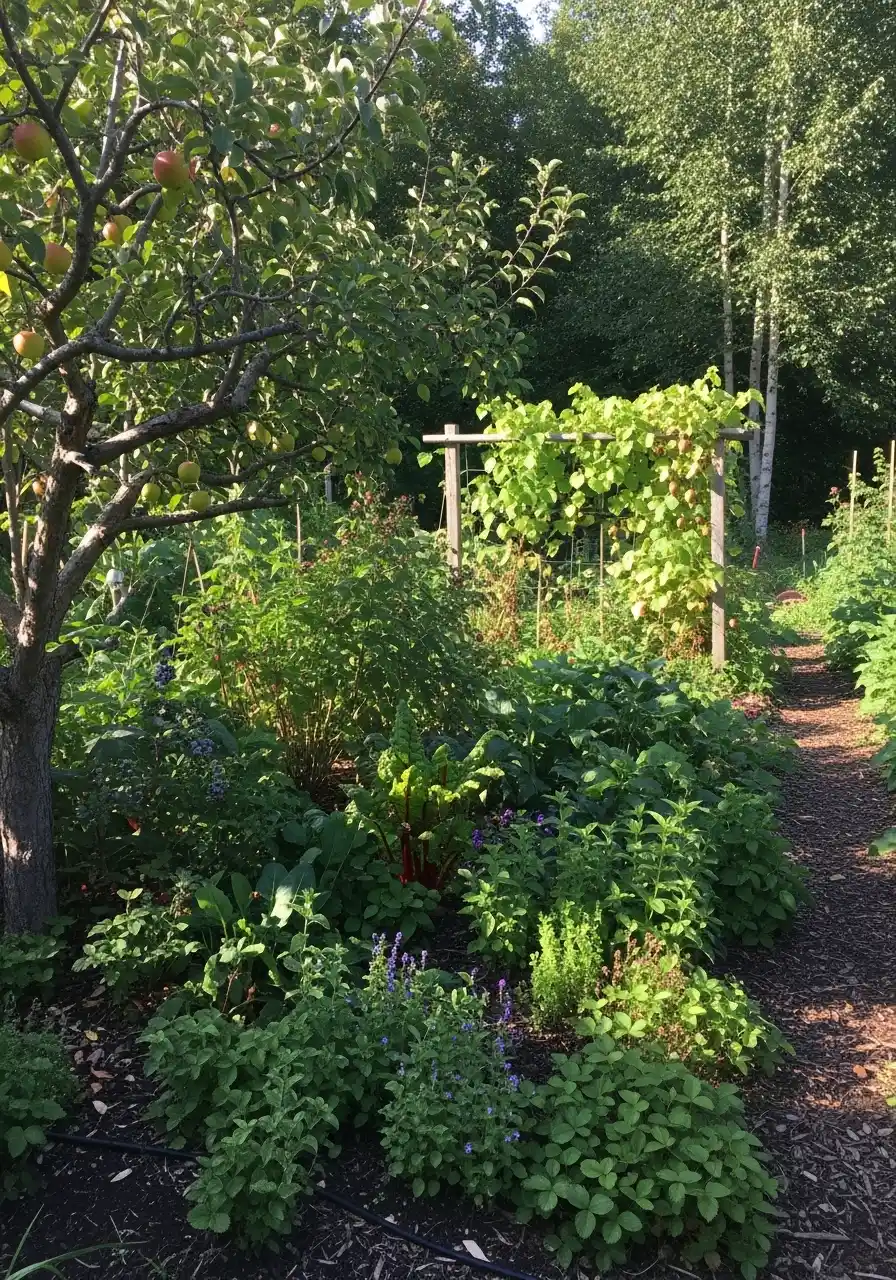
This one feels like the full system working. Fruit trees overhead, lots of mixed plants underneath, climbing beans on trellises, herbs spilling into the edges, and one clear path going through it all. It looks productive but still peaceful. Like, you could harvest and also just breathe.
If you want this as your end goal, start simple. Plant a few fruit trees. Add berry shrubs. Add herbs. Then layer in annual veggies in open sun pockets. You don’t have to do it all at once. Doing everything at once is how people burn out and quit.
And keep your path sacred. I mean it. Don’t let plants swallow it. A food forest garden should feel like abundance, not frustration. You should be able to walk through with a basket and not fight for your life.
A “welcome bed” that introduces the whole system
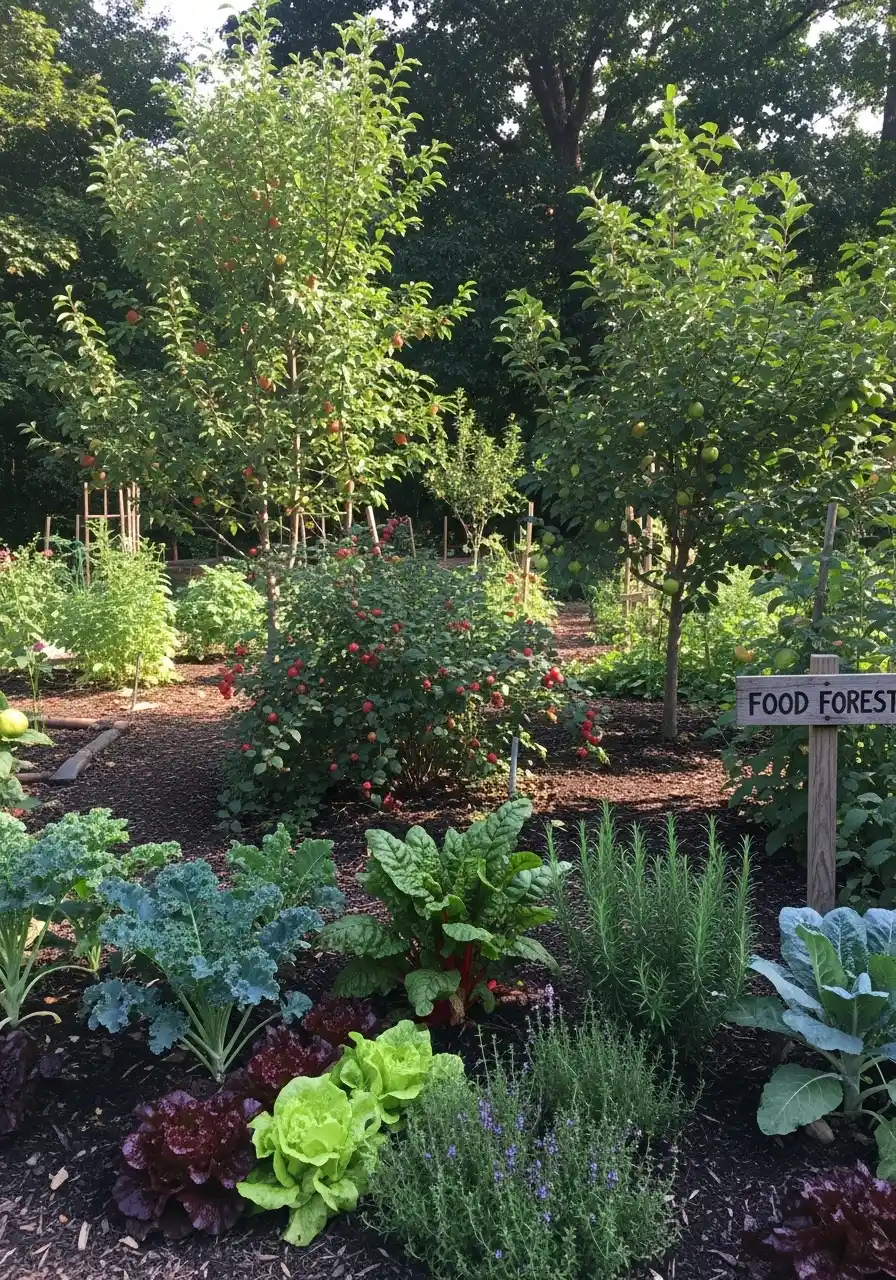
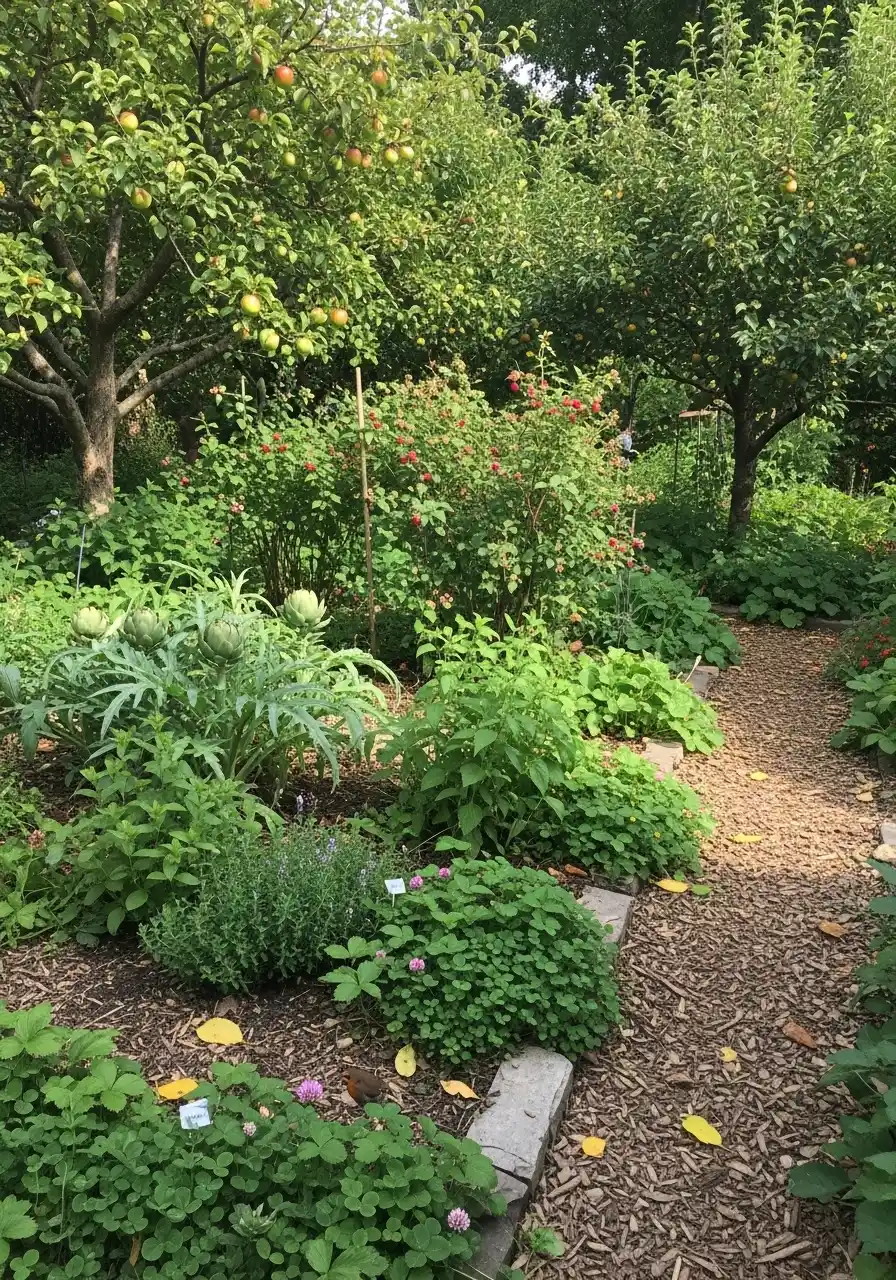
This garden has that sign that literally says FOOD FOREST, and I love it because it’s like a public promise. The bed in front is packed with greens, herbs, and a few flowers, and then fruit trees rise up behind it. It feels like an entrance, like you’re stepping into a place that’s meant to feed people. The mulch paths keep it clean and walkable, and the way everything is spaced makes it feel calm, not crowded.
If you want food forest garden ideas that don’t overwhelm you, start with an “intro bed” like this. Put your easy stuff in front. Lettuce, kale, chard, rosemary, thyme. Add a small berry bush too, because berries make you feel rich even when you’re not. The hack is to keep the edge neat. When the edge is neat, the inside can be a little wild and it still looks good. I’m not even kidding, edges are like makeup for gardens.
Tidy mulch path with a living tunnel vibe: the easy way to stay on track
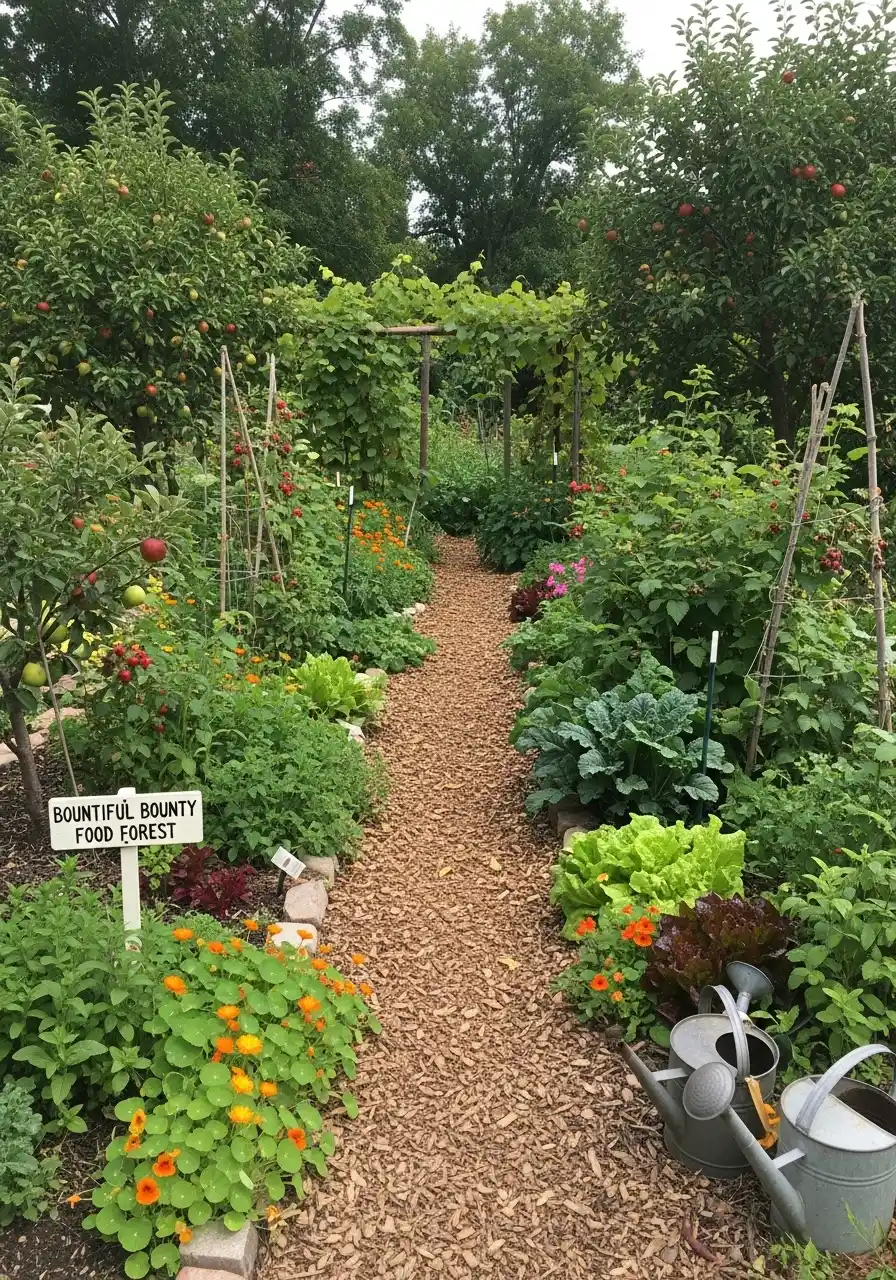
This one has a straight mulch path down the middle, with fruit trees and mixed plants on both sides. There’s a sign that says “Bountiful Bounty Food Forest,” which is honestly the cutest thing. You can see trellises, herbs, leafy greens, and flowers like nasturtiums spilling out near the path. It feels productive but also friendly, like you’re allowed to touch stuff.
For food forest garden ideas that actually work long-term, paths are everything. If you can’t walk through your garden easily, you stop going out there. That’s just real life. Keep your path wide enough for a wheelbarrow, and refresh the woodchips once or twice a year. Also, plant flowers close to the path edges, because they pull pollinators in and make the whole space feel joyful. Variation wise, this is like a “food forest garden layout idea” that stays organized even when plants get big.
Understory planting under fruit trees: the cozy, shady layer that feels like magic
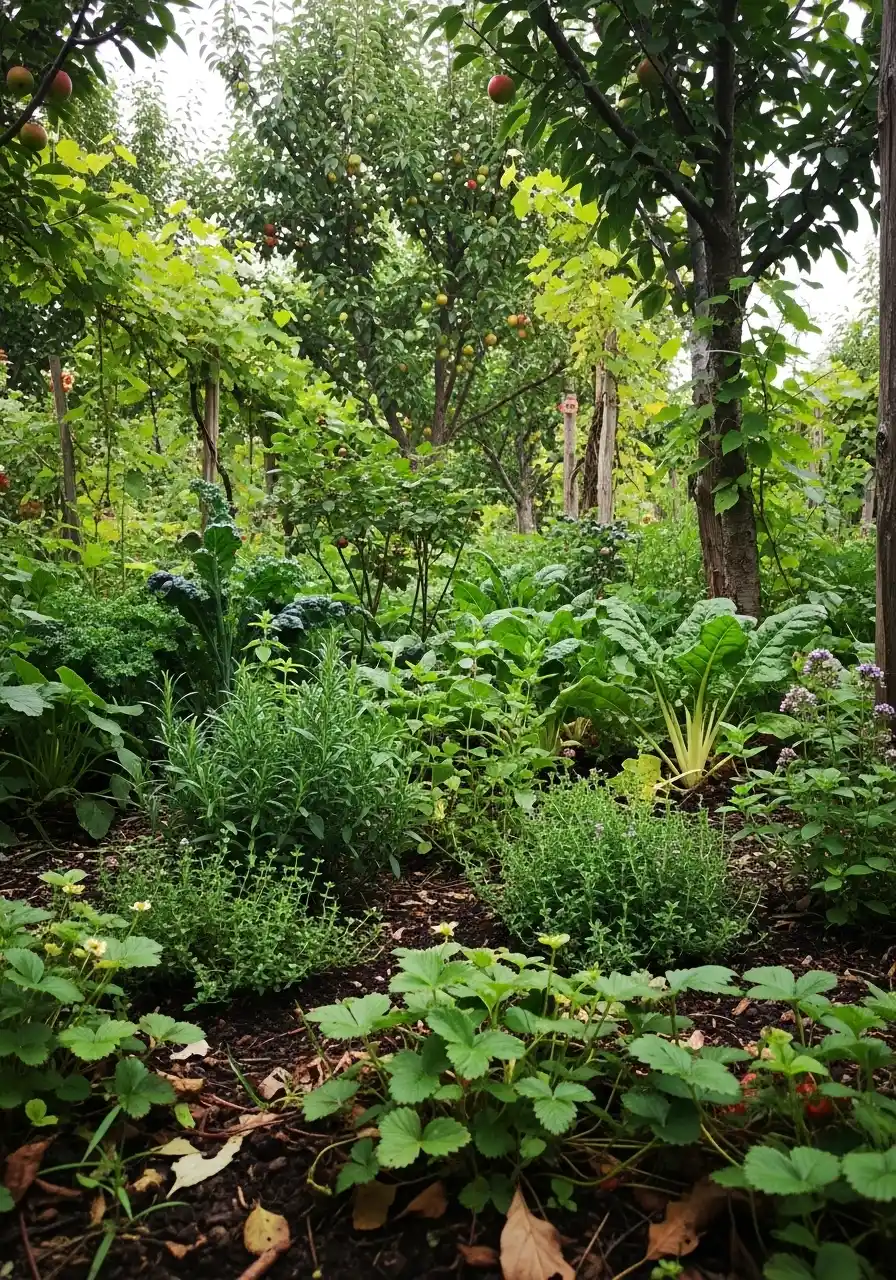
This image is my favorite kind of messy. It’s the shady understory under trees, with herbs, greens, and groundcovers filling in the gaps. You can see a thick carpet of plants, and it feels like the garden is doing its own thing. This is the part of food forest gardening that made me go, ohhhh, I get it now. You’re not fighting nature. You’re guiding it.
If you want food forest garden ideas for under trees, pick plants that can handle partial shade. Mint (but watch it, it spreads), thyme, chives, sorrel, and some leafy greens. You can even tuck strawberries in as a groundcover, which is basically the best surprise snack ever. The hack is mulch and moisture. Trees suck up water, so you need extra mulch to hold moisture in, and you may need drip irrigation if it’s dry where you live. This is one of those food forest garden ideas that looks “wild pretty” but it’s actually planned.
Curved woodland path with signs: a food forest that feels like a walk in the woods
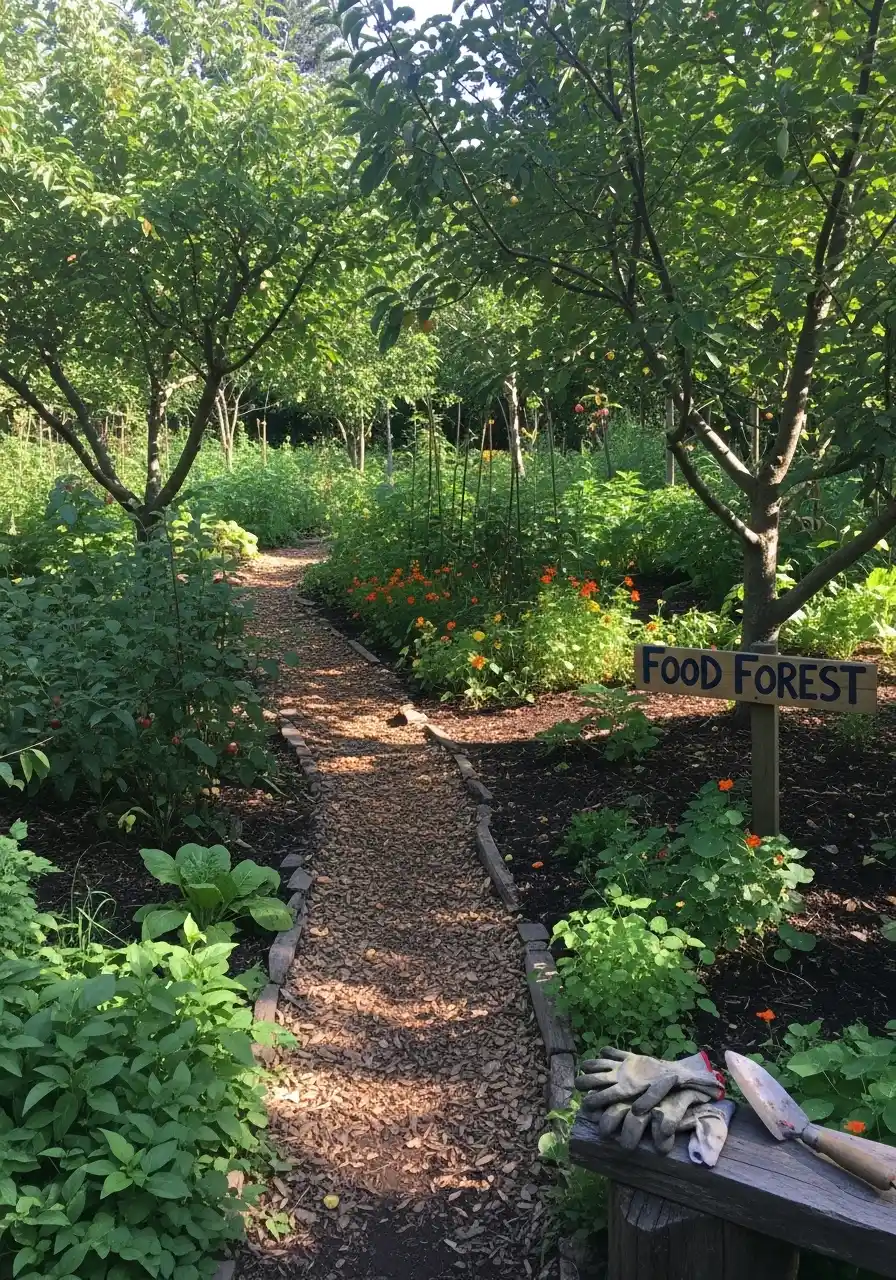
This one feels like a secret trail. There’s a winding woodchip path, fruit trees overhead, and a “Food Forest” sign pointing you in. It feels peaceful, like a mini park, but then you notice all the edible stuff tucked everywhere. Flowers in patches, herbs spilling out, and low greens near the ground. I like that it’s not rigid. It’s more like “follow the path and harvest what you need.”
If you want food forest garden ideas that feel relaxing, go curved instead of straight. Curves make it feel softer and less “farm row.” Use simple edging like logs or stones to keep chips from drifting. And put a little bench or tool spot nearby, because you’ll stay longer if you can set stuff down. I also love using signs, not even for guests, but for me. I forget what I planted sometimes, no shame.
Strawberry + herb guilds under trees: small details that make the whole thing work
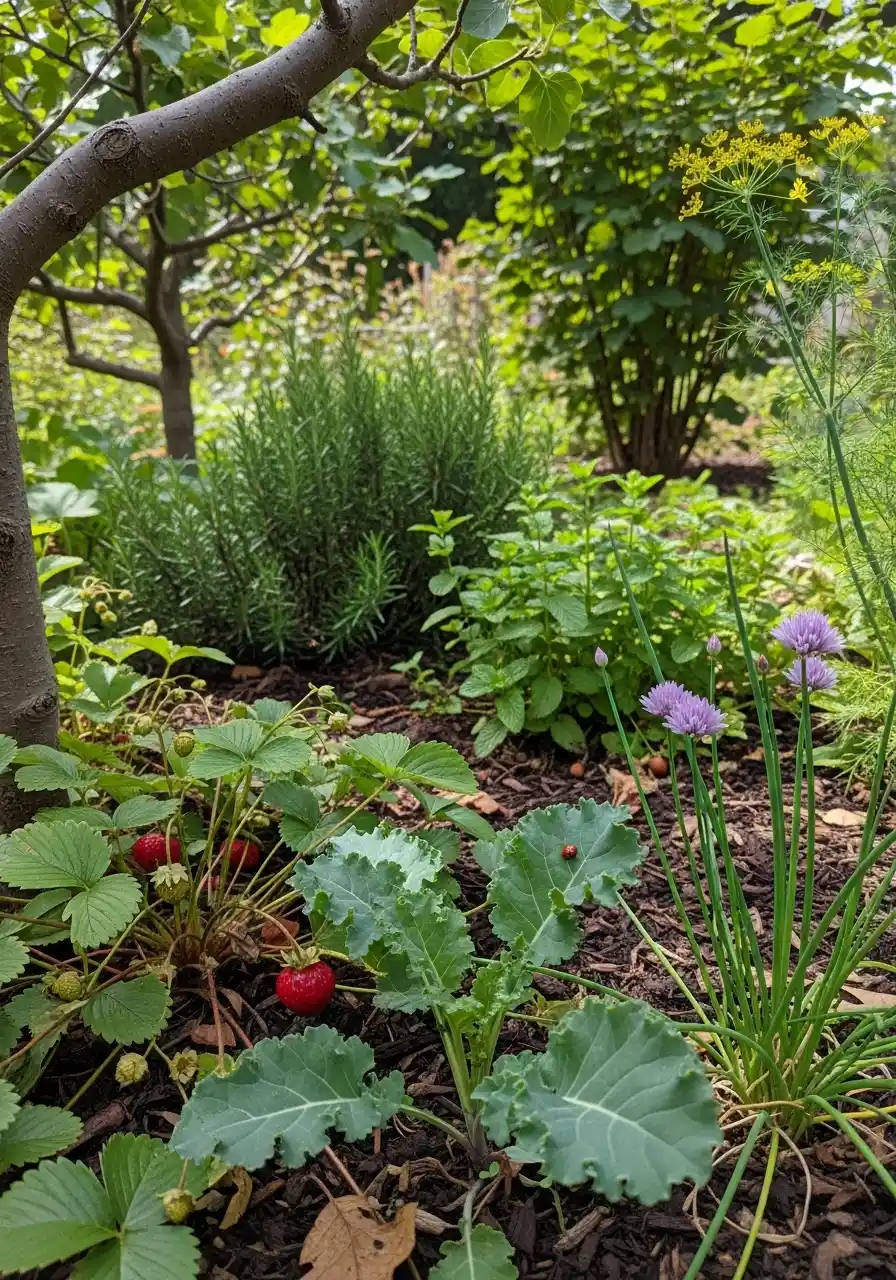
This last one zooms in on the tiny layers that matter. Strawberries creeping along the ground, chives popping up like little purple fireworks, and herbs like dill nearby. You can tell it’s under a tree canopy, and the soil looks mulched and soft. This is what makes food forest garden ideas so good. It’s not just “big trees,” it’s the tiny helper plants that protect soil and bring bugs and keep weeds down.
If you want a simple food forest garden idea, make a little guild like this around one tree. Strawberries as groundcover, chives to confuse pests, dill to attract beneficial insects, and a sturdy herb like rosemary if your climate allows. Keep a small open ring around the trunk so you don’t trap moisture against it. That’s a common mistake. And yeah, I’ve done it. This is a food forest gardening idea that’s small enough for beginners but still feels like a real system.
Conclusion
These food forest garden ideas feel so good because they’re not just pretty. They’re useful. They’re the kind of garden where you walk out, pick something, smell herbs, hear bees, and you feel like you’re part of the place instead of fighting it. The biggest lesson I keep seeing is: build the path first, then layer plants in a way that makes sense. Keep it walkable, keep it snackable, and don’t try to do everything in one season. I’m saying that for you, but also for me, because I get carried away.